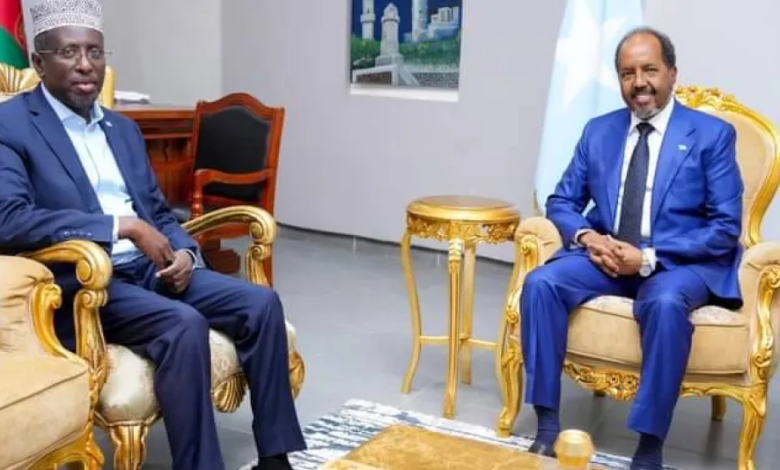

In a political move aimed at easing tensions and containing internal strife, Somali President Hassan Sheikh Mohamud held a significant meeting with one of the country's most prominent political opposition leaders. This move comes at a critical juncture for Somalia, as the political leadership seeks to unify ranks to confront escalating security and political challenges, both domestically and regionally.
Context of the meeting: The search for national consensus
This meeting cannot be viewed in isolation from the broader political landscape in Mogadishu, which has recently witnessed sharp political tensions surrounding key issues, most notably the proposed constitutional amendments and the distribution of powers between the federal government and regional states. These issues have provoked the ire of opposition forces, who have repeatedly called for a comprehensive consensus before any changes affecting the structure of the state are implemented. This meeting is a positive indication of the Somali presidency's desire to open direct channels of communication with the opposition to bridge differences and prevent any slide into political crises that could derail the nation-building process.
Security importance: Uniting efforts against terrorism
This step is of paramount importance given the fierce war the Somali government is waging against the extremist group al-Shabaab. The Somali president and political leaders understand that victory in this existential battle requires a cohesive and stable domestic front. Political fragmentation often gives terrorist groups an opportunity to regroup and reorganize. Therefore, easing political tensions with the opposition is a pressing security imperative to ensure the continued military momentum recently achieved by the Somali National Army in the central and southern parts of the country.
Regional and international dimensions
Regionally, Somalia faces complex geopolitical challenges in the Horn of Africa, necessitating a unified national stance to bolster Somali diplomacy on the international stage. The president's success in containing the opposition sends a reassuring message to the international community and donor partners that Somalia is on the path to political stability, encouraging continued international support for development programs and debt relief.
In conclusion, this meeting represents a glimmer of hope for the Somali public, which aspires to see its political elite transcend narrow partisan differences in favor of higher national interests, at a stage that requires everyone to join forces to bring the country to safety.