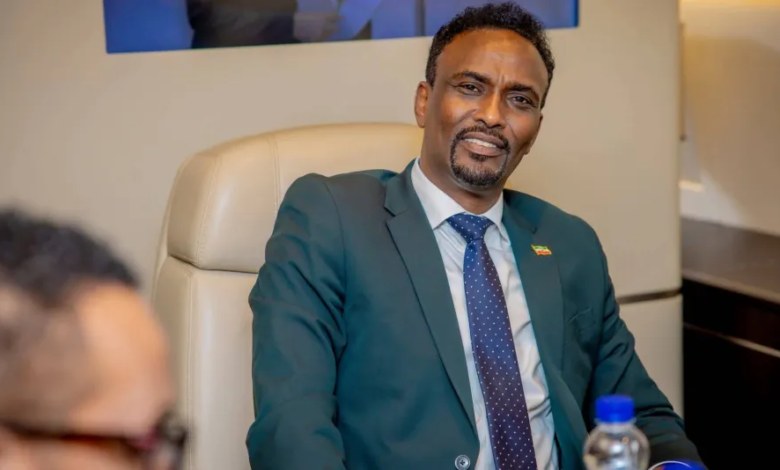

The Foreign Minister of the Republic of Somaliland, Issa Kayed, categorically denied recent media reports claiming that his government had reached an agreement or intended to receive Palestinian refugees from the Gaza Strip. This statement put an end to rumors circulating in some Israeli and international media outlets, which alleged that secret negotiations were underway between the two sides to resettle a number of Gazans in Somali territory in exchange for political or financial incentives.
Details of the official denial and the government's position
The Ministry of Foreign Affairs of Somaliland affirmed its unwavering stance on the Palestinian issue and stated that it has not engaged in any such talks. Officials clarified that the dissemination of such news is intended to sow confusion, emphasizing that Somaliland, despite its tireless efforts to gain international recognition of its independence, cannot compromise humanitarian principles or participate in schemes that could harm the future of the Palestinian people or contribute to the liquidation of their cause through forced displacement.
The context of the rumors: the search for "voluntary migration"
This news comes within a broader context related to the ongoing war in the Gaza Strip, where reports have surfaced indicating that the Israeli government is seeking countries willing to accept Palestinians under the guise of "voluntary migration." Previous press reports had mentioned other African countries, such as Congo, Rwanda, and Chad, as potential destinations, which those countries also categorically denied. Observers suggest that the inclusion of Somaliland's name may be an exploitation of its unique political status as an internationally unrecognized state seeking political legitimacy, making it a fertile ground for speculation.
Somaliland: Political Background and the Quest for Recognition
Somaliland unilaterally declared its independence from Somalia in 1991 following the collapse of the central government in Mogadishu. Despite enjoying political and security stability, its own currency, and its own army, it has yet to receive formal international recognition. The government in Hargeisa is pursuing various diplomatic avenues to bolster its international standing, and recently signed a controversial memorandum of understanding with Ethiopia granting it access to the sea, a move that has sparked regional tensions. Against this complex backdrop, rumors about accepting refugees from Gaza are emerging as political trial balloons that quickly burst in the face of official realities.
Regional and international stance on displacement
Somaliland's denial is particularly significant given the Arab and African consensus against the principle of displacing Gaza's population. Egypt and Jordan consider any attempt to expel Palestinians from their land a "red line" and a liquidation of the Palestinian cause. Consequently, any state, whether recognized or not, that agrees to such plans will face isolation and sharp criticism from the Arab and Islamic world. This denial underscores Somaliland's commitment to the general stance supporting the Palestinians' right to remain on their land and its refusal to engage in solutions that come at the expense of the humanitarian suffering in Gaza.