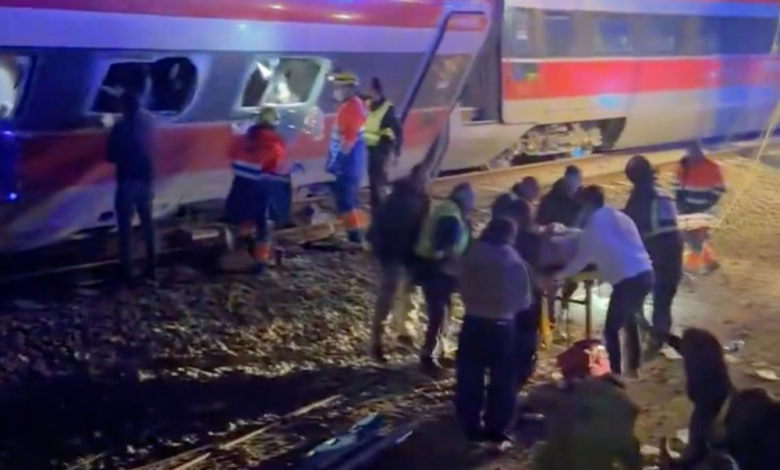
Death toll from train collision in Spain rises to 39; details of the disaster emerge

In a tragic development in the disaster that struck Spain's transport sector, the Spanish Interior Ministry announced Monday morning that the death toll from the high-speed train collision that occurred Sunday evening in the southern region of Andalusia has risen to at least 39. These new figures revise the initial count of 24 fatalities, reflecting the immense scale of the devastation caused by the accident.
According to official sources, the horrific accident also left approximately 123 people with injuries of varying severity, including five critical cases and 24 others in serious condition. Health authorities mobilized all available personnel, and the injured were quickly transported to hospitals in the cities of Córdoba and Andújar for treatment, as confirmed by the Andalusian ambulance service via the X platform.
The incident occurred at 7:45 PM local time when an Aero train traveling from Malaga to Madrid suddenly derailed. This resulted in a violent collision with a Renfe train traveling in the opposite direction on the adjacent track towards Huelva. Transport Minister Oscar Puente described the scene as horrific, confirming that the force of the impact caused the first two carriages of the Renfe train to completely derail.
Context of the accident and railway infrastructure
Spain boasts one of the world's most advanced rail networks, with the second-largest high-speed rail (AVE) network after China. The line connecting Madrid and Andalusia (including Malaga and Seville) is a vital artery of the country's transport network, carrying millions of passengers annually. The recent entry of private companies like Aero into the Spanish market following the liberalization of the rail sector has further increased the frequency of travel on these crucial lines.
Despite the high safety record of Spanish trains, this incident brings to mind previous accidents and raises questions about the challenges of managing heavy train traffic at high speeds, especially in areas that require precise maneuvers or have complex geographical terrain, such as those north of Malaga.
Emergency response and expected repercussions
In response to the seriousness of the situation, the Spanish Army's military emergency unit was deployed to the scene to support the civil defense and ambulance teams. A field hospital was also set up near the collision site to triage patients and provide first aid before transport. Technical teams are currently working to secure the area in preparation for a thorough technical investigation to determine the root causes of the derailment of the Irio train.
This incident is expected to have far-reaching consequences, not only locally in Spain but also for European safety measures. The railway safety authority is likely to launch a comprehensive investigation, including a review of signaling systems, track maintenance, and emergency protocols at operators. The incident may also cause temporary disruptions to transport between the south and the capital, which will have economic and logistical repercussions for the region in the coming days.