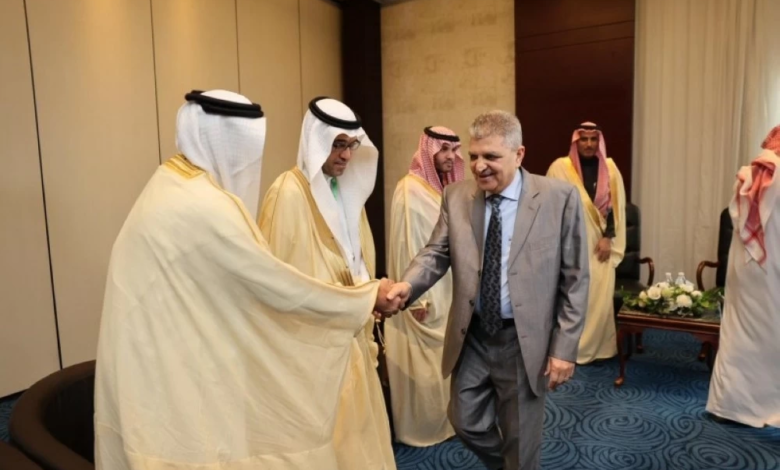

In a move reflecting the depth of economic and strategic relations between Cairo and Riyadh, the Suez Canal Authority and the Saudi General Authority for Ports discussed prospects for joint cooperation to enhance maritime and logistical readiness, in preparation for the return of major international shipping lines to operate at full capacity through the Red Sea.
This came during a high-level meeting between Lieutenant General Osama Rabie, Chairman of the Suez Canal Authority, and Professor Suleiman bin Khalid Al-Mazrou, Chairman of the Saudi Ports Authority, on the sidelines of the annual International Maritime Transport and Logistics Conference (MARLOG), where the two sides discussed ways to develop a comprehensive partnership that keeps pace with the rapid changes in the maritime transport industry.
Enhancing logistics and infrastructure
The meeting addressed the establishment of implementation mechanisms for cooperation in vital areas, including the provision of integrated logistics services, the construction of marine units and equipment, as well as dredging and dock maintenance. This step comes at a time of increasing need to develop port infrastructure to accommodate the new generation of mega-ships, thus enhancing the position of Saudi ports and the Suez Canal as key hubs in global supply chains.
Lieutenant General Osama Rabie reviewed the previous successful cooperation experience, in which the Maritime Simulation and Training Academy of the Authority modeled the Saudi port of “Ras Al-Khair”, a project that paved the way for the duplication of the approach channel and received widespread praise, confirming the ability of Egyptian shipyards to localize the maritime industry and provide products of global quality and competitive prices.
Strategic importance and stability of navigation in the Red Sea
For his part, the head of the Saudi Ports Authority emphasized the pivotal role of the Suez Canal in ensuring the stability and sustainability of global trade through the Bab el-Mandeb Strait and the Red Sea. He noted that improved security in the region necessitates heightened readiness to accommodate the resumption of maritime traffic, and expressed the Kingdom's desire to benefit from Egypt's extensive experience in dredging and berth development, particularly in light of the major expansion projects underway at Jeddah Islamic Port.
Economic and regional dimensions
This cooperation is particularly important given the recent challenges facing international shipping, as Egyptian-Saudi coordination represents a cornerstone of energy and trade security in the region. This integration contributes to supporting the Kingdom's Vision 2030, which aims to transform Saudi Arabia into a global logistics hub, in parallel with Egypt's efforts to maximize the benefits of the Suez Canal Economic Zone.

The two sides concluded the meeting by emphasizing that the next phase will witness the transformation of these understandings into tangible executive partnerships, in a way that serves the common interests of the two brotherly countries and supports the smooth flow of international trade.