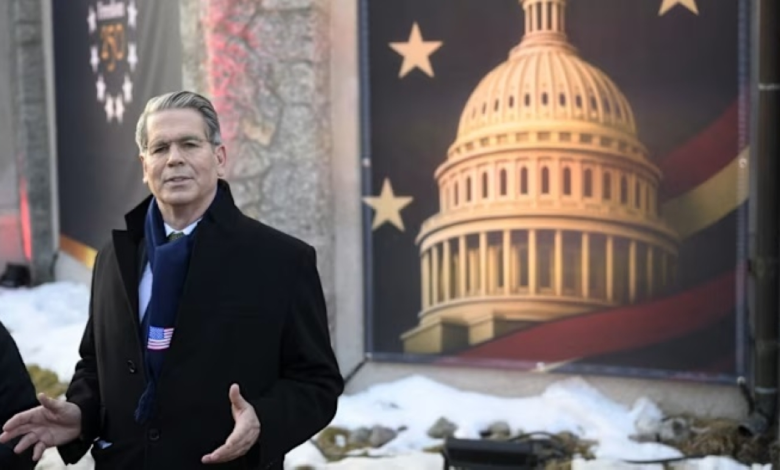
US Treasury Secretary Scott Bisnett issued a stern warning to European countries against retaliating with tariffs in response to President Donald Trump's economic threats regarding his bid to acquire Greenland. His remarks came on the sidelines of the World Economic Forum in Davos, where escalating transatlantic trade tensions are a major focus.
Warnings of an open trade war
Speaking to reporters, Bessent described any European move to impose retaliatory tariffs as “unwise,” noting that economic escalation would not serve the interests of the continent. He emphasized that President Trump’s insistence on annexing Greenland stemmed from a profound strategic vision of American national security, stating, “We will not entrust the security of the Western Hemisphere to any other party,” a clear indication of Washington’s rejection of any competing foreign influence in that vital region.
The strategic and economic importance of Greenland
The United States' interest in Greenland is not a recent development or simply a real estate deal; it is based on established geopolitical and economic realities. The island enjoys a strategically vital position in the Arctic and already hosts Thule Air Base, a cornerstone of the US missile early warning system. Furthermore, Greenland possesses vast reserves of rare earth minerals, which are essential to modern technology industries, from smartphones to electric vehicle batteries and military guidance systems.
In this context, Bessent pointed to international competition for the island's resources, criticizing the permission granted to China to conduct mining operations there, and emphasizing that American control would ensure that these vital resources would not fall under the domination of strategic competitors.
Historical background: This is not the first attempt
It is worth noting that Washington's desire to buy Greenland is not unprecedented; the United States first offered to purchase the island in 1867, and then renewed the offer in 1946 under President Harry Truman for $100 million in gold. However, Denmark rejected both offers. Bisent cited successful historical deals to bolster his argument, asking, "How did the United States acquire the Panama Canal? We bought it from the French," and also pointing to the purchase of the Virgin Islands from Denmark in 1917.
Nobel controversy and diplomatic tension
On another note, Bessent addressed the controversy surrounding Trump's letter to the Norwegian Prime Minister, in which some linked the Greenland issue to his failure to win the Nobel Peace Prize. Although Bessent denied knowing the details of the letter, he described the connection as "absurd." Trump had previously stated that the world would not be safe unless the United States controlled Greenland, arguing that his efforts to end wars deserved international recognition.
These developments come at a time when the European Union is considering its options for responding to US threats, amid fears that the dispute over the icy island could destabilize traditional Western alliances and fuel a global trade war.