The Sun's Halo in Winter: Secrets of the Phenomenon and an Explanation from Jeddah Astronomy

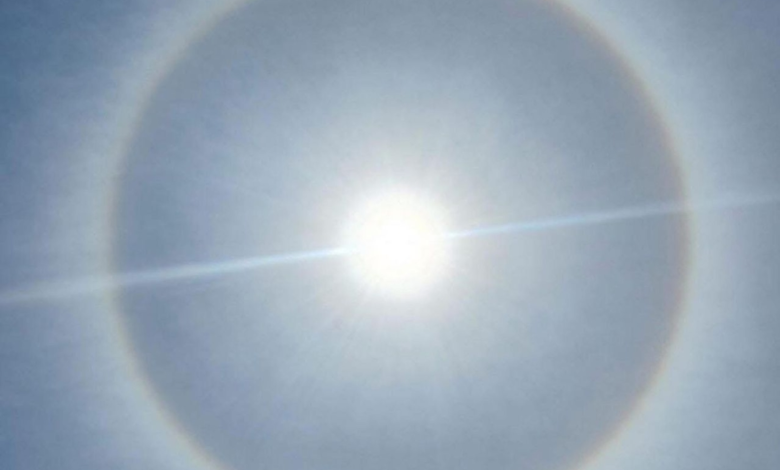
The Jeddah Astronomical Society revealed precise scientific details about one of the most captivating atmospheric phenomena that graces the skies of the Arab world during winter: the "sun halo." Engineer Majid Abu Zahra, head of the society, explained that this time of year is the most suitable for observing this magnificent ring of light surrounding the sun, giving the sky an exceptional spectacle that combines beauty and physics.
Scientific explanation: Atmospheric physics
The sun's corona, appearing as a circular ring with an angular diameter of 22 degrees, is not merely an optical illusion but the result of a complex physical process known as light refraction. This corona forms when sunlight passes through hexagonal ice crystals suspended in thin, high-altitude clouds (crystalline clouds) that float at altitudes of 6 to 13 kilometers above the Earth's surface. At these high altitudes, temperatures are extremely low, even if the weather is warm on the surface, allowing these crystals to form.
Climatic and historical indicators
Historically, this phenomenon was not merely an aesthetic sight; ancient peoples and farmers relied on it as a weather forecasting indicator. Scientifically, the presence of cirrostratus clouds, which create the halo, often signals the approach of a warm or moist air front, implying a likelihood of rainfall within the following 24 hours. This logical connection between the phenomenon and climate change gives it a functional dimension in addition to its aesthetic appeal.
The mechanism of action of a natural glass prism
Abu Zahra explained that the ice crystals act like a prism; white light enters them and is refracted at a 22-degree angle, breaking it down into its constituent colors. This is why the inner edges of the halo appear faintly red, while the colors gradually diffuse outwards, and the sky inside the ring appears darker because light is not refracted in that specific area. This phenomenon occurs globally, but the clear winter skies in the Arab region make it more easily observable.
Similar phenomena and important warnings
In addition to the sun's corona, the head of the Jeddah Astronomical Society discussed other phenomena such as "diamond dust," which occurs in extremely cold atmospheres near the Earth's surface, and "corona," which is associated with water droplets. In closing, Abu Zahra emphasized the need for strict safety precautions during observation, warning against looking directly at the sun due to the potentially severe damage it can cause to the retina. He advised using natural barriers, such as buildings, to block the sun's disk and instead observing the surrounding corona.