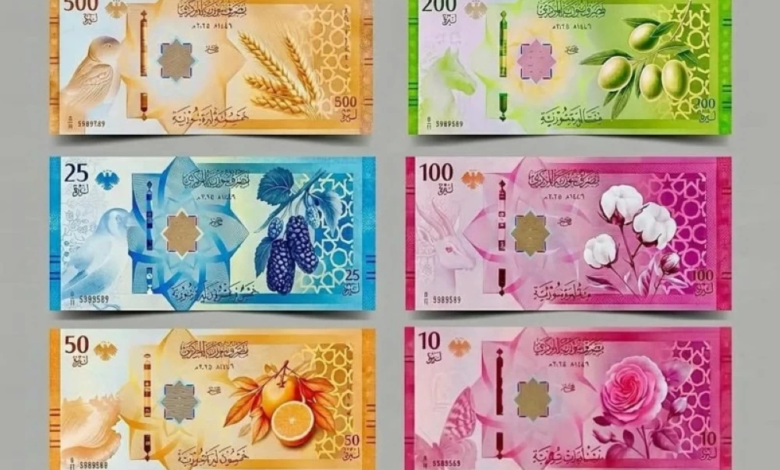

The Central Bank of Syria officially announced the introduction of the new Syrian currency into circulation, a strategic move aimed at restructuring the monetary system and strengthening financial stability in the country. This step comes in response to current economic challenges, as the bank seeks, through this measure, to facilitate daily transactions for citizens and merchants and create a more attractive environment for local and foreign investment, which will positively impact overall commercial and economic activity.
According to the Syrian Arab News Agency (SANA), the new banknotes are specifically designed to facilitate cash transactions and reduce the time and effort required to count and transport money. They also aim to minimize logistical burdens and risks associated with handling large amounts of cash with low purchasing power. The agency noted that currency stability and a stable exchange rate are fundamental pillars for creating a favorable investment climate, which contributes to improving income and living standards and represents a genuine starting point for comprehensive and sustainable economic transformation.
In detailing the implementation mechanism, the Central Bank of Syria explained that the exchange process will be carried out according to a specific monetary formula, whereby every 100 Syrian pounds of the old currency will be equivalent to one Syrian pound of the new issue. The bank has set a 90-day timeframe for the exchange process, with the possibility of extending this period to ensure that the new currency reaches all segments of the population and sectors in all governorates.
Economic context and historical background
This move comes at a time when the Syrian economy is facing inflationary challenges that have accumulated over years of crisis, leading to a significant erosion of the purchasing power of the national currency and a substantial increase in the money supply. Countries often resort to policies such as "removing zeros" or issuing new currency with adjusted nominal values as a technical and psychological solution to combat hyperinflation and to simplify accounting and financial operations for companies and institutions struggling to manage the astronomical figures in their balance sheets.
Importance and expected impact
Domestically, this measure is expected to simplify daily transactions for Syrian citizens, reducing the need to carry large amounts of banknotes for simple purchases. On a broader economic level, the introduction of a new currency sends a positive signal about the monetary authorities' desire to regulate the market and control the money supply, which could bolster confidence in the banking system. Regionally and internationally, the stability of the national currency is a prerequisite for attracting foreign capital and stimulating trade, as investors prefer to operate in environments with clear and stable monetary systems, free from sharp exchange rate fluctuations.