Total Lunar Eclipse March 3, 2026: Details of the phenomenon and where to view it

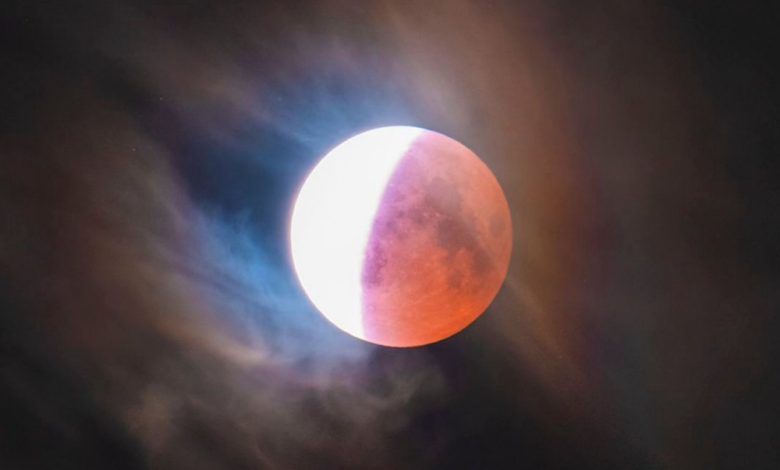
The Jeddah Astronomical Society, through its president, Engineer Majid Abu Zahra, announced a significant astronomical event that will occur on Tuesday, the 14th of Ramadan 1447 AH (corresponding to March 3, 2026): a total lunar eclipse. This eclipse is the first of two lunar eclipses that will take place that year. However, this remarkable astronomical phenomenon will not be visible in Saudi Arabia or most of the Arab world, as it will occur during daylight hours in those regions.
In the technical details of the event, Abu Zahra explained that the eclipse will be clearly visible across a wide geographical area encompassing most of East Asia, Australia, the Americas, and the Pacific Ocean. Conversely, the spectacle will be completely absent from the skies of Saudi Arabia, the Middle East, Africa, and Europe, as the moon will be below the horizon throughout all phases of the eclipse, thus preventing residents of these regions from witnessing this change in the moon's color.
Timing and phases of the eclipse
According to precise astronomical calculations, the lunar eclipse will begin at 11:44 AM Mecca time and end at 5:22 PM. During this period, the moon will pass through all phases of the eclipse. This phenomenon coincides with the moon passing its perigee (closest point to Earth) six days before reaching its apogee (farthest point) seven days before reaching its eclipse, making it appear almost its usual apparent size at the peak of the event.
The physics behind the color red
From a scientific perspective, this event offers an opportunity to understand the interactions of light with Earth's atmosphere. When the Moon enters Earth's shadow, it doesn't disappear completely but takes on a coppery-red hue. This phenomenon is known as Rayleigh scattering, the same physical phenomenon that gives the sky its blue color and sunrises and sunsets their reddish hues. Earth's atmosphere scatters the blue wavelengths of light coming from the Sun, while allowing the longer red wavelengths to pass through and be refracted onto the Moon's surface, giving it its distinctive glow.
Scientific importance that goes beyond mere observation
The head of the Jeddah Astronomical Society affirmed that a total lunar eclipse is not merely an aesthetic spectacle, but also a significant scientific opportunity for scientists and researchers. By studying the moon's color and brightness during an eclipse, precise information can be gleaned about the state of Earth's atmosphere and the proportion of dust and aerosols suspended within it, including volcanic ash. This data effectively contributes to improving climate models and gaining a deeper understanding of atmospheric dynamics.
In addition, lunar eclipses allow scientists to study the thermal response of the lunar surface. With direct sunlight blocked, the surface temperature drops dramatically and rapidly, potentially exceeding 100 degrees Celsius in a short time. This sudden temperature change helps scientists understand the nature of lunar soil and rocks and how they retain or lose heat, enriching our geological knowledge of Earth's only natural satellite.
Context of the phenomenon and correction of misconceptions
In concluding his report, Abu Zahra emphasized the importance of using precise scientific terminology, noting that the term "blood moon," circulated by some media outlets, is an unscientific and relatively recent description, and is not considered authoritative in astronomical circles. He pointed out that this eclipse is classified as a "non-central" total eclipse, where the moon does not pass directly through the center of the Earth's shadow but rather tilts towards its southern edge, which may make its northern edge appear slightly darker.