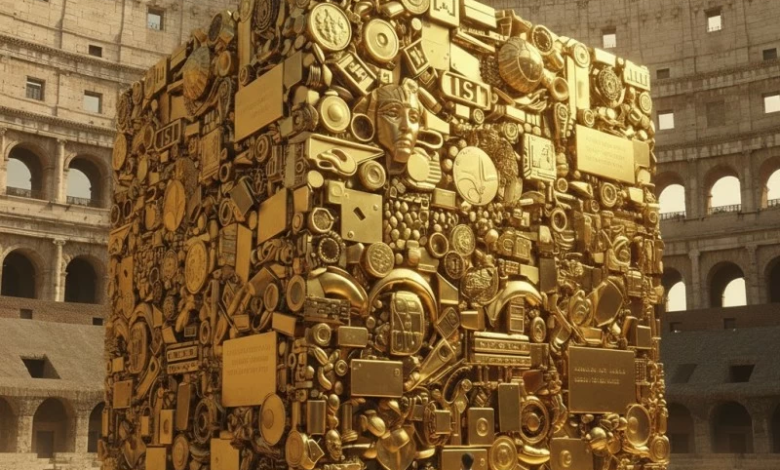
When we talk about global wealth, the yellow metal that has captivated minds since the dawn of history immediately comes to mind. But did you know that all the gold ever mined by humankind over thousands of years could fit inside a cube with sides measuring just 22 meters? This seemingly modest figure holds immense economic value, forming one of the cornerstones of the modern global economy.
The History of Gold: From Ancient Civilizations to the Modern Era
In ancient times, gold was not merely an ornamental metal; it was a symbol of power and immortality. Historical studies indicate that ancient civilizations, such as the Egyptians and Romans, revered this metal for its rarity and unique physical properties. However, the true boom in gold mining only occurred in modern times. According to data from the World Gold Council , total gold production reached approximately 219,000 tons Remarkably, about two-thirds of this amount was produced after 1950, reflecting the tremendous technological advancements in mining operations and the surge in global demand.
Why doesn't gold disappear?
The most important chemical characteristic of gold is that it is a precious metal that does not tarnish, rust, or corrode over time. This leads to an astonishing fact: most of the gold ever mined is still among us today . The ring you wear today may be made from recycled gold from ancient Roman coins or pharaonic jewelry. Gold is melted and reshaped repeatedly without losing its properties, making it an eternal store of value.
Global gold distribution: Where does the precious metal go?
Looking at a map of the distribution of mined gold around the world, we find that the uses vary between adornment, investment and sovereign reserves, and the approximate percentages are as follows:
- 44% (Jewelry): The jewelry industry accounts for the largest share, especially in huge markets such as India and China.
- 23% (Investment): Includes bullion, gold coins and exchange-traded funds (ETFs).
- 18% (Central Banks): Countries hold huge gold reserves to support their currencies and hedge against economic crises.
- 15% (Other uses): Gold is used in precision industries, electronics, and dentistry thanks to its high conductivity and corrosion resistance.
Are we facing a gold shortage?
Economists and geologists are raising a pressing question: Could gold run out? Current geological estimates suggest that the known and recoverable underground reserves amount to only about 55,000 tons . While other potential resources are estimated at around 132,000 tons, extracting them faces enormous technical, economic, and environmental challenges.
This relative scarcity, coupled with the difficulty of discovering new, rich deposits, is what reinforces gold's status as a "safe haven." During times of inflation, war, or financial market turmoil, investors and nations turn to gold to preserve wealth, ensuring its continued influence on the global economy for many years to come.