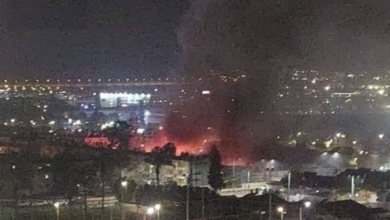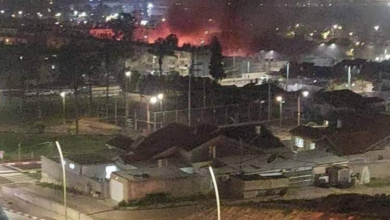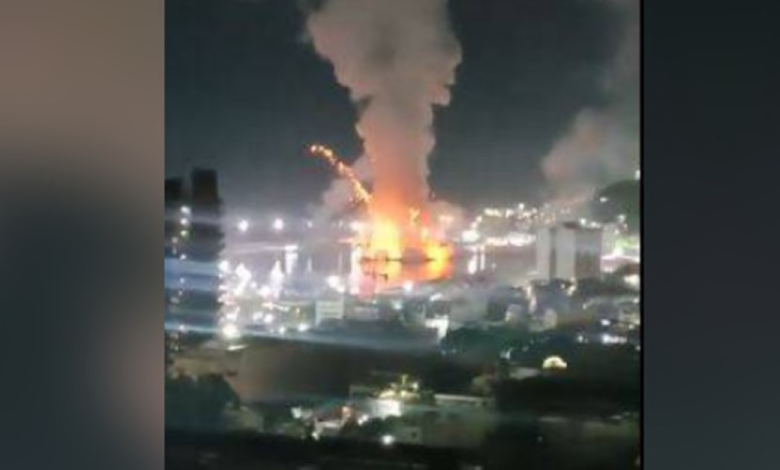

Donald Trump announced on Saturday that US forces had successfully carried out a large-scale military operation inside Venezuelan territory, resulting in the capture of President Nicolás Maduro and his wife, Cilia Flores. Powerful explosions rocked the capital, Caracas, and its suburbs at midnight, signaling the start of the operation, which US officials described as the beginning of a “new dawn” for the country.
Details of the operation and Maduro's transfer to New York
President Trump revealed that special forces extracted Maduro and his wife from their hiding place using military helicopters, which immediately transported them to a U.S. Navy ship, from where they would be taken to New York. Trump indicated that the Venezuelan president would face federal charges in U.S. courts, a move reminiscent of previous indictments by the U.S. Department of Justice against Venezuelan officials on charges related to terrorism and drug trafficking.
For her part, Venezuelan Vice President Delcy Rodriguez demanded that the United States provide concrete evidence proving that Maduro and his wife are still alive, confirming that contact with them has been lost.
Context of the US-Venezuelan conflict
This event cannot be separated from a long history of tension between Washington and Caracas. For years, the United States has imposed crippling economic sanctions on Venezuela's oil sector, accusing the Maduro regime of undermining democracy and violating human rights. Venezuela, which possesses the world's largest proven oil reserves, is a geopolitical battleground between American influence and Eastern powers such as Russia and China, which have provided Maduro with economic and military support for years to ensure his continued hold on power.
International reactions: sharp division
The attack sparked a wave of mixed reactions reflecting the international divide over the legitimacy of military intervention and regime change by force:
The US position and the Venezuelan opposition
The Venezuelan opposition celebrated the operation, with opposition leader María Corina Machado declaring that "the moment of freedom" had arrived and calling for the transfer of power to opposition candidate Edmundo González. In Washington, senators and officials, including Christopher Landau, confirmed that the operation had been a success.
Latin America: Rejection of Intervention
Anger prevailed in major Latin American capitals, where the operation was seen as a violation of sovereignty:
- Brazil: President Lula da Silva strongly condemned the attack, describing it as going beyond acceptable limits and threatening the region as a zone of peace.
- Colombia: President Gustavo Petro announced the mobilization of troops on the border, calling for an emergency meeting of the Organization of American States to discuss this “aggression”.
- Mexico: warned that military action jeopardizes regional stability, rejecting unilateral measures.
Russia and China: Condemnation of “hegemony”
Eastern powers took a firm stance against the operation. Russia the attack as an “armed aggression” reflecting ideological hostility, demanding Maduro’s immediate release. China its deep shock, asserting that the US’s hegemonic behavior seriously violated international law and threatened peace in the Caribbean.
Europe and the United Nations: Concern and calls for restraint
The European and international stance was characterized by caution and a focus on international law:
- United Nations: Antonio Guterres warned of a “dangerous precedent,” expressing concern over the lack of respect for international law.
- Britain and France stressed the need to respect international law, with Paris emphasizing that political solutions cannot be imposed from the outside, while the British Prime Minister denied any involvement of his country in the process.
- Italy and Poland: Italian Prime Minister Giorgia Meloni defended the right of countries to defend themselves against “drug-supporting regimes,” while Polish Prime Minister Donald Tusk warned of the repercussions of this event on the entire world at the beginning of 2026.
This event presents the world with open scenarios, both regarding Venezuela's internal future and the possibilities of a political vacuum, and the impact of this on global energy markets and the already strained relations between the Western and Eastern blocs.