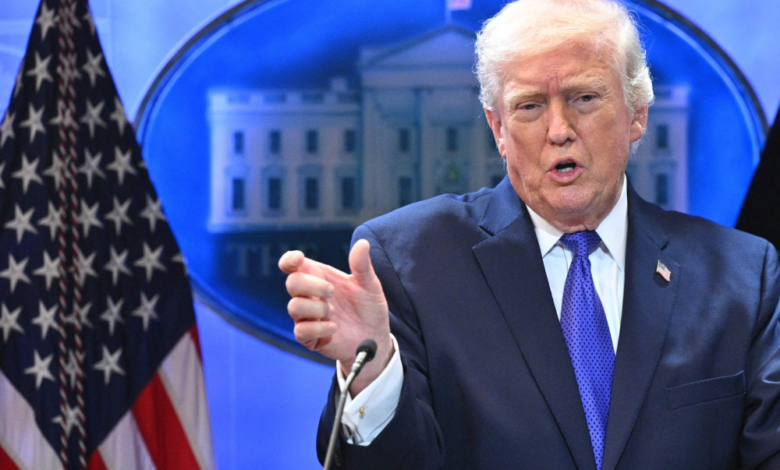
In a new chapter of the conflict between the executive and judicial branches in the United States, US President Donald Trump his scathing attack on the Supreme Court on Monday, accusing it of "bias towards China" and "incompetence," following its recent decision to cancel a large part of the tariffs he had previously imposed.
Attack via "Truth Social" and accusations of bias
Through his social media platform, Truth Social, Trump launched a fierce attack on the judges, suggesting that their next expected step would be "to rule in favor of China and other countries." The US president described the court's decision as "ridiculous and stupid," noting that it had caused a sharp division internationally.
In his posts, Trump said, "The Supreme Court has found a way to reach a false conclusion, a conclusion that will please and enrich China and other countries once again." He added defiantly that the court had inadvertently given him, as President of the United States, "far more power and influence" than he possessed before their decision, hinting at the use of other alternative powers.
Background and context: "America First" policy and the trade war
This escalation comes as Trump clings to his protectionist economic policies under the banner of "America First," viewing tariffs as a key tool to protect American industries and reduce the trade deficit. Analysts point out that the Supreme Court's decision represents a significant blow to this strategy, as it limits the president's ability to impose tariffs without congressional approval, which explains the White House's angry reaction.
Historically, successive US administrations have relied on a balance of power, but Trump’s repeated use of executive orders to impose a new economic reality, especially towards China and the European Union, has put US institutions to a real test of their constitutional powers.
Threats of using "licenses" and punitive measures
Trump didn't stop at criticism; he moved to direct threats, asserting his ability to use "licenses" to do what he called "absolutely terrible" things to foreign countries, particularly those he accused of plundering the United States for decades. The US president warned that any country attempting to exploit the Supreme Court's decision to play "games" would face tariffs "much higher" and worse than any previous tariffs.
On Saturday, one day after the court ruling, Trump announced his intention to raise his new global tariffs from 10% to 15% "with immediate effect," a move that observers interpreted as an attempt to circumvent the court ruling and assert his authority.
Expected economic and political repercussions
This conflict is causing widespread concern in global markets, with economists fearing that Trump's insistence on escalating tariffs could lead to a full-blown trade war that would disrupt global supply chains and drive up prices for consumers. Furthermore, the executive branch's continued questioning of the Supreme Court's legitimacy and competence casts a shadow over the stability of democratic institutions in the United States.
Trump concluded his remarks with a clear message of defiance: "Let our Supreme Court continue to make bad decisions that are detrimental to the future of our nation. I have work to do," hinting at more unilateral economic decisions in the coming period.