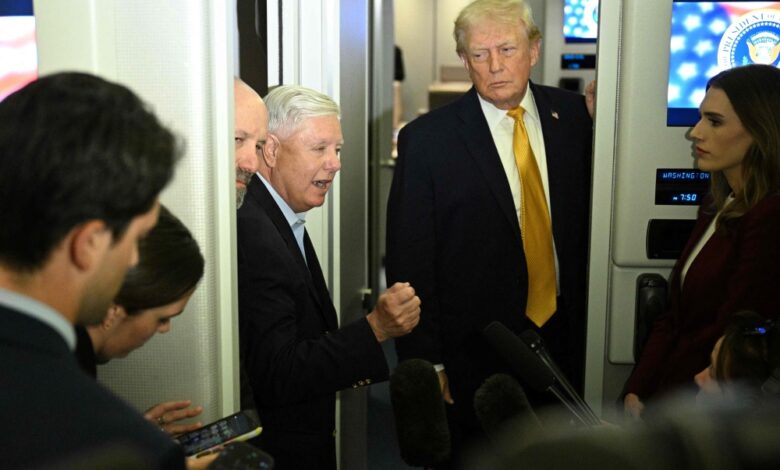

US President Donald Trump expressed deep skepticism regarding the Russian account accusing Ukraine of launching a large-scale drone attack on Russian President Vladimir Putin's residence. Speaking from Air Force One, Trump told reporters on Sunday that he "doesn't believe that strike actually happened," citing a lack of conclusive evidence and emphasizing the continued uncertainty surrounding the incident. "Nobody knows yet whether the Russian claims are true," he said.
Details of the Russian accusations and the Ukrainian denial
The US president's remarks come at a time of escalating tensions between Moscow and Kyiv, with Russian authorities accusing Ukraine of carrying out a complex drone attack on the night of December 28-29, targeting Putin's heavily guarded Valdai residence between Moscow and St. Petersburg. According to the Russian Defense Ministry, 91 drones were used in the alleged attack, which it described as "precisely planned and executed.".
In response, Kyiv swiftly and categorically denied these accusations, describing them as a "lie" propagated by Moscow for political and military purposes. Ukrainian officials asserted that these claims were intended to create a pretext for launching new retaliatory attacks on Ukrainian cities, as well as to undermine any emerging international diplomatic efforts to end the conflict.
The context of war and information warfare
This event cannot be separated from the broader context of the ongoing war, where drones have become a key strategic weapon for both sides. However, targeting high-level command centers, specifically the Russian president's residence, represents a dangerous escalation in the rules of engagement, if the reports are accurate. Observers believe the timing of this Russian announcement raises questions about whether it is part of an "information war" that parallels the ground battles, as each side seeks to sway international public opinion or justify harsh military actions.
Political and diplomatic repercussions
This alleged incident has implications that extend beyond the immediate military aspect; the Kremlin has explicitly warned that this attack will harden its negotiating position in any future talks aimed at ending the war. This threat suggests that Moscow may use the Valdai incident as leverage to raise its demands or refuse to make concessions, further complicating an already complex political landscape.
For his part, Trump's skeptical stance reflects the general Western caution toward accepting Russian accounts without independent evidence. International affairs experts point out that Washington's skepticism puts pressure on Moscow to provide more credible evidence, especially since Europeans and military experts have expressed surprise at how such a large number of drones were able to penetrate deep into Russian territory and reach even the most heavily fortified areas without being intercepted.
Russian attempts at proof
In an attempt to dispel international skepticism, the Russian Ministry of Defense released videos showing the wreckage of a drone that crashed in a snow-covered wooded area, along with testimonies from local residents and soldiers. The Russian military also presented a map illustrating the flight paths of the 91 drones. However, the question raised by Trump remains: is this evidence credible and sufficient to prove Kyiv's involvement in an operation of this scale and audacity?.