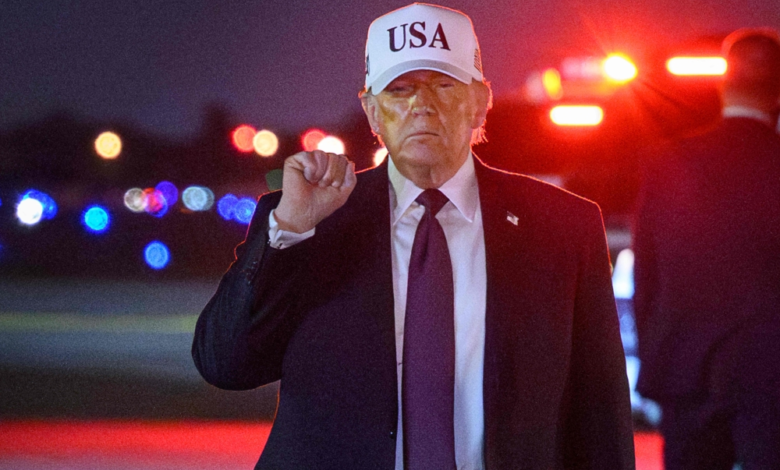

In recent remarks characterized by their sharp tone and high confidence, US President Donald Trump asserted that the United States is currently in a "very strong position" in its confrontation with Iran, emphasizing that the primary objective of the ongoing operations is to ensure the complete and irreversible denuclearization of Iran. These remarks were made during a meeting at the White House with several top executives from American technology companies, where he addressed developments on the fifth day of the military operations mentioned by the source.
Firm messages to the Iranian leadership
In discussing the Iranian leadership, Trump used veiled threats, suggesting that their leadership was "fading away and disappearing rapidly." He made his controversial statement: "It seems like everyone who wants to be a leader there ends up dead," a clear reference to the immense military and intelligence pressure exerted by Washington and its allies. These remarks reflect Trump's long-standing "maximum pressure" strategy, which aims to cripple the adversary's capabilities and strip it of its regional power.
The historical context of the conflict and the nuclear issue
To understand the dimensions of this escalation, it is necessary to return to the roots of the dispute over the Iranian nuclear program. Successive US administrations, particularly Republican ones, have consistently considered Tehran's acquisition of a nuclear weapon a red line that cannot be crossed, as it threatens US national security and the security of its allies in the Middle East, most notably Israel. The current actions are part of a long series of economic sanctions, withdrawals from previous agreements, and even direct confrontation, all aimed at ensuring that Iran does not reach the nuclear threshold.
Strategic dimensions and balance of power
Trump's talk of a "position of strength" refers to the qualitative military and technological superiority enjoyed by the United States, as well as its control of vital airspace and waterways. Analysts believe that Washington, through this escalation, seeks to impose new negotiating terms that would not only ensure the dismantling of Iran's nuclear infrastructure, but also curb its influence in neighboring countries and reduce its missile arsenal.
Expected regional and international impacts
This event has far-reaching implications that extend beyond Iran's borders. Continued military operations and tensions in the Arabian Gulf could directly impact global energy markets and oil prices. This firm American stance also sends reassuring messages to regional allies who have long expressed concern about Iranian expansionism. Conversely, it presents the international community with a difficult test in containing the situation and preventing the region from sliding into a protracted, full-scale war, at a time when Washington is seeking a swift resolution based on its overwhelming military power.