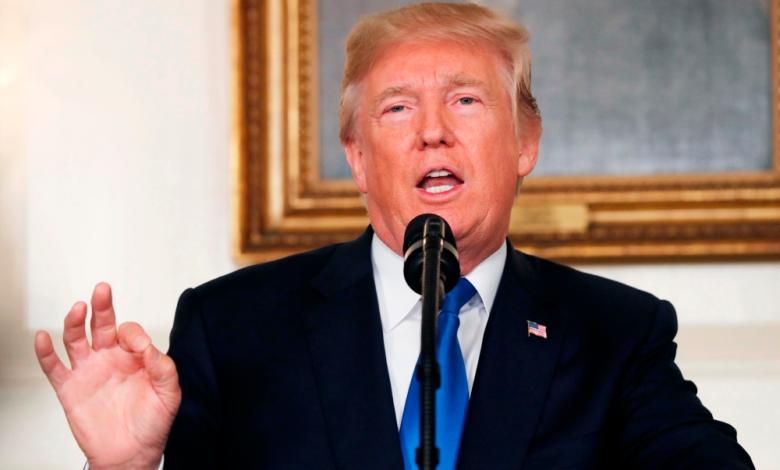
US President Donald Trump asserted that the world will soon learn the nature of the American response to the attack targeting the US embassy in the Saudi capital, Riyadh. His remarks underscored Washington's commitment to protecting its interests and diplomatic missions in the region, while also indicating a military strategy that does not necessarily rely on a large number of troops on the ground.
Details of the attack and the official response
In a related development, media reports quoted President Trump as saying, "I don't think deploying ground troops in Iran would be necessary," suggesting that a potential US response might rely on targeted strikes or other deterrent strategies, rather than a traditional ground invasion. This statement comes after the US embassy in Riyadh was attacked by two drones, resulting in a small fire and minor material damage to the building, with no casualties reported.
For his part, the official spokesman for the Ministry of Defense explained via the “X” platform that initial estimates indicate that the attack was carried out by two drones, stressing that the situation was under control and that the damage was limited to material aspects only.
The political and diplomatic dimensions of the event
This event is of particular importance given the status of diplomatic missions under international law. Embassies are considered protected areas under the Vienna Convention on Diplomatic Relations, and any attack on them constitutes a flagrant violation of international norms and state sovereignty. Targeting an embassy as significant as the US embassy in a pivotal country like Saudi Arabia carries serious escalatory implications, requiring a response that ensures such security breaches are not repeated.
Strategic partnership and balance of power
This development comes at a time of complex political and security tensions in the region. Saudi Arabia is a key strategic partner of the United States in the Middle East, with close cooperation in areas such as counterterrorism, energy security, and regional stability. Therefore, any threat to American interests within the Kingdom should not be viewed as an isolated incident, but rather as a political message that could have repercussions on the balance of power in the region.
The future of dealing with modern threats
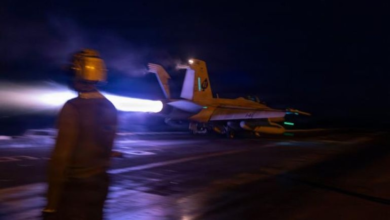
Trump’s declaration excluding ground troops signals a shift in US military doctrine toward relying on advanced technology, precision airstrikes, and cyber warfare to counter threats, rather than engaging in protracted ground wars. This approach reflects a desire to achieve effective deterrence at the lowest possible human and material cost, while maintaining a high level of readiness to address any potential escalation that threatens the security of diplomatic missions or allies in the Arabian Gulf.