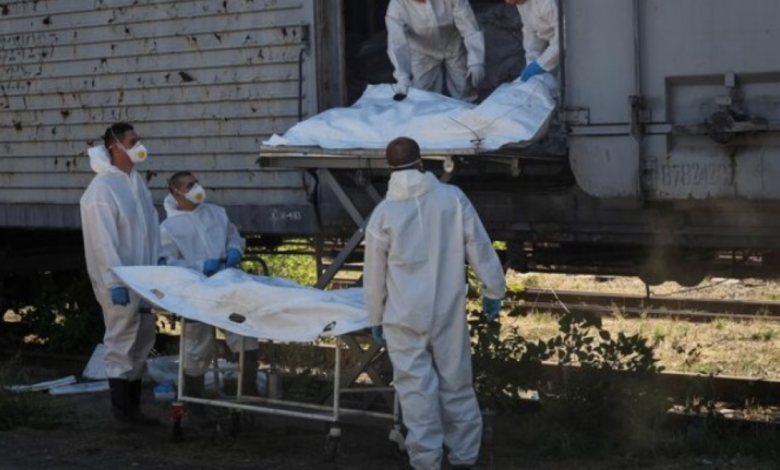
In a significant development concerning humanitarian operations and the exchange of prisoners and remains between the warring parties, Kyiv announced on Thursday that it had received from Russia the bodies of 1,000 people whom Moscow identified as Ukrainian soldiers killed in the ongoing fighting. This operation is one of the largest repatriation of remains since the outbreak of the war, highlighting the immense human cost of the fierce battles on various fronts.
The Ukrainian center responsible for prisoner of war cases stated in an official statement published on social media: "Today, complex humanitarian procedures were carried out for the return of remains, under which Ukraine 1,000 bodies that the Russian side claims belong to Ukrainian soldiers." In contrast, Moscow indicated that it received the remains of only 38 Russian soldiers from the Ukrainian side, a significant discrepancy reflecting the complex nature of the negotiations and the challenging field conditions surrounding the collection of remains from the conflict zones.
The importance and context of remains exchange operations
The exchange of bodies is a vital and sensitive part of managing the ongoing conflict, primarily aimed at giving soldiers' families the opportunity to bury and bid farewell to their loved ones. This carries significant moral and humanitarian weight for both Ukrainians and Russians. Upon arrival, these bodies typically undergo thorough forensic examinations, including DNA analysis, to definitively identify them before being released to their families. This process can be lengthy due to the large number of bodies and their condition after being recovered from the battlefield.
NATO strengthens its defenses with advanced technologies
Beyond the humanitarian dimension, and on the strategic military front, NATO to drastically bolster its defenses along its European border with Russia over the next two years. This move is part of the alliance's deterrence strategy to prevent any potential spillover of the conflict into European territory and to secure its eastern flank, which is experiencing unprecedented tensions since the Cold War.
In an effort to reduce human risk by relying on modern technology, the alliance is working to create an "automated defense zone" that depends on equipment and systems operating almost without direct human intervention. According to a German general who spoke to the press on Saturday, this approach reflects NATO's desire to leverage its technological superiority to create smart defense lines.
General Thomas Lowen, deputy chief of operations at NATO's Allied Land Command in Izmir, Turkey, told the German newspaper Welt am Sonntag that this defensive belt would include a no-go zone that any hostile force would have to cross before advancing, describing it as a "kind of hot zone" that would be supported by sensors and automated deterrence systems, thus changing the shape of expected traditional confrontations in the future.