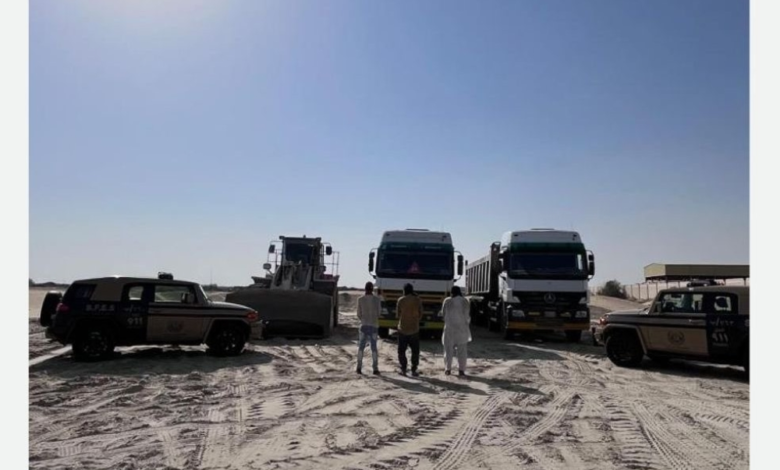
Environmental security forces apprehend violators of hunting and grazing regulations in Riyadh and Medina

The Special Forces for Environmental Security continued their intensive field efforts in various regions of the Kingdom of Saudi Arabia to ensure compliance with the environmental system and its executive regulations. Recently, they were able to apprehend a number of violators in the Riyadh and Madinah regions. Their violations ranged from hunting without a license, overgrazing, exploiting sediments, and entering protected areas with vehicles.
Details of the crackdown on hunting violations in King Khalid Reserve
As part of its mission to protect wildlife, the Special Forces for Environmental Security apprehended two citizens for violating environmental regulations by hunting without a license within the King Khalid Royal Reserve . An air rifle was found in their possession, and legal procedures were immediately applied to them.
In its statement, the forces stressed the need for strict adherence to the environmental system, warning that penalties will be imposed on anyone who violates the regulations. It explained that the penalty for hunting in prohibited areas is a fine of (5,000) riyals, while the penalty for hunting without a license is a fine of (10,000) riyals, in order to deter violators and protect biodiversity.
Overgrazing violations in the Imam Turki bin Abdullah Reserve
In a related incident, and in cooperation with the Imam Turki bin Abdullah Royal Reserve Development Authority, authorities apprehended a citizen for grazing twelve camels in prohibited areas within the reserve. The authorities confirmed that the penalty for grazing camels in restricted areas is a fine of 500 riyals per camel, noting that overgrazing is a major cause of desertification and the degradation of vegetation cover.
Exploiting sediments and dredging soil in Medina
In the Madinah region, field patrols apprehended a Pakistani resident who violated environmental regulations by illegally extracting sediment and excavating soil using two heavy machines, which were seized at the site. This action aims to mitigate the geological and environmental damage caused by the removal and excavation of soil without official permits, which negatively impacts the land and flood channels.
Protecting vegetation in the King Abdulaziz Reserve
The forces also apprehended a citizen who violated regulations by driving his vehicle into the meadows and gardens belonging to the King Abdulaziz Royal Reserve. The forces clarified that the penalty for vehicles entering protected wild meadows and gardens is 2,000 riyals, due to the damage caused by vehicle tires to vegetation and the obstruction of the growth of wild grasses and shrubs.
The context of national efforts and environmental protection in accordance with Vision 2030
These ongoing security operations are part of the Kingdom of Saudi Arabia’s ambitious environmental protection strategy, a cornerstone of Vision 2030 and the “Green Saudi Arabia” initiative. These efforts aim to develop vegetation cover, combat desertification, protect endangered wildlife, and restore the ecological balance of nature reserves.
The wise leadership has given great attention to establishing royal reserves and creating the Special Forces for Environmental Security as a specialized enforcement body to ensure the firm application of regulations and raise public awareness of the importance of preserving natural resources for future generations. These forces act as a protective shield for nature, confronting all forms of environmental aggression, whether it be poaching, illegal logging, or soil pollution.
Call to report
The Special Forces for Environmental Security reiterated their call to all citizens and residents to contribute to environmental protection by immediately reporting any incidents of environmental or wildlife abuse. Reports can be made by calling 911 in the Makkah, Madinah, Riyadh, and Eastern regions, and 999 or 996 in the rest of the Kingdom. The forces emphasized that all reports will be treated with the utmost confidentiality.