
In a significant step aimed at transforming the urban landscape, the Strategic Development Office for Al-Jawf Region has introduced a new policy to standardize lighting codes within the region's urban areas. This initiative was launched through the "Istilaa" platform of the National Competitiveness Center. It is part of efforts to regulate the nighttime landscape and enhance the visual identity, aligning with the goals of the Kingdom's Vision 2030 to improve the quality of life and elevate the urban environment of Saudi cities.
Cultural context and future vision
This regulation is not merely a technical procedure, but rather part of a comprehensive development initiative underway in the Kingdom to eliminate visual pollution and unify architectural and urban character. The Al-Jawf region holds particular significance due to its historical depth and rich heritage, making controlled lighting a crucial factor in showcasing the region's beauty at night. The policy aims to create visual harmony that blends tradition and modernity, with well-planned lighting contributing to transforming cities into attractive tourist and economic destinations, and supporting the concept of "humanizing cities," which seeks to make the built environment more suitable and comfortable for residents and visitors.
Details of technical specifications and color codes
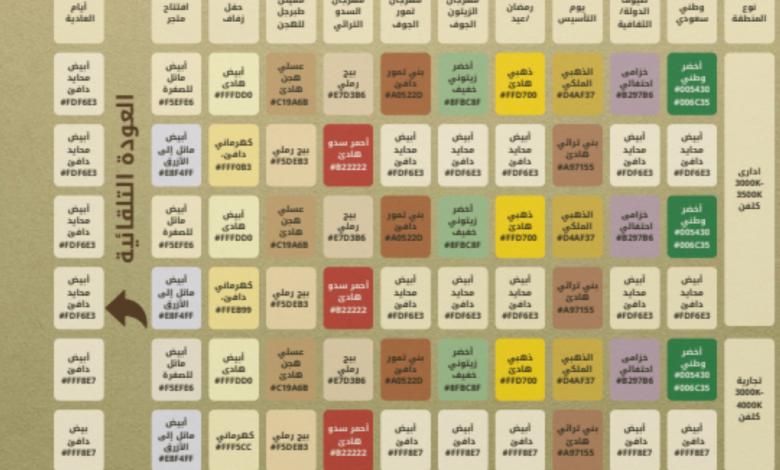
The draft policy provided detailed specifications for the color temperatures (Kelvin) and color codes (HEX) adopted for each range, to ensure there was no randomness:
- Historic areas: Warm lighting ranging between 2700 and 3000 Kelvin (traditional white) with a color code "HEX: #FFE4B5" was adopted to give an authentic character that is appropriate to the heritage buildings and historical castles that abound in the area.
- Commercial areas: These have been designated with temperatures between 3000 and 3500 Kelvin (warm white) with the code "HEX: #FFF8E7", to stimulate commercial activity and attract shoppers while maintaining eye comfort.
- Administrative areas: They adopt the neutral white color in shades between 3000 and 4000 Kelvin with the code "HEX: #FDF6E3", to reflect the official character and clarity in the headquarters of government agencies and public squares.
Expected impact: A sustainable environment and a safe nighttime landscape
The implementation of this policy is expected to yield numerous benefits at both the local and national levels. Environmentally, technologies for controlling and distributing light intensity will reduce light pollution and glare, thus limiting energy consumption and protecting the night sky. Socially, standardized lighting will enhance traffic safety and security within neighborhoods, and provide residents with visual comfort by preventing outside light from entering homes.
The policy also took into account operational flexibility, as it developed a special matrix for global events and occasions (such as health awareness campaigns), allowing for temporary color changes to interact with international events without compromising the city's basic identity, thus placing Al-Jawf among the regions that apply the latest global standards in urban planning.