
The Philippine Air Force officially announced today the conclusion of a series of intensive joint air military exercises with the United States Air Force, which took place in sensitive strategic locations on Luzon Island and over the waters of the West Philippine Sea (South China Sea), in a move that carries profound strategic implications in light of current regional tensions.
Details of the joint military exercises
Philippine Air Force spokesperson Cristina Pascoe explained in a detailed official statement that the exercises took place from February 2nd to 6th. Pascoe confirmed that the bilateral participation included a complex series of coordinated air activities primarily aimed at enhancing interoperability and improving military and tactical cooperation between Philippine and U.S. forces.
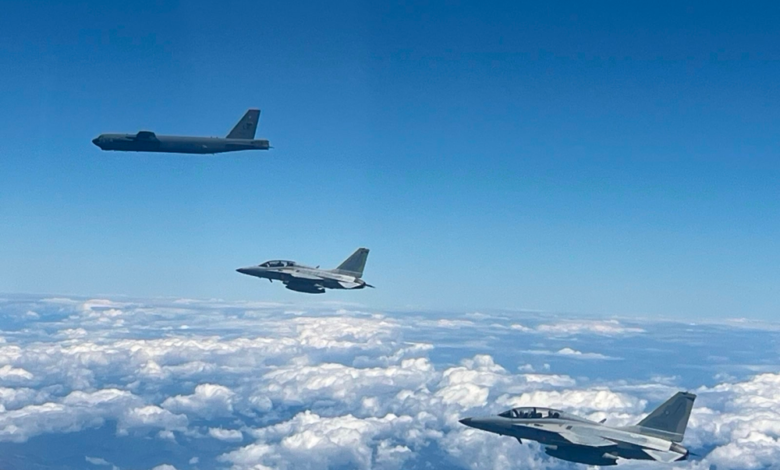
The spokesperson added that air force units from both countries conducted joint air patrols involving strategic bombers, as well as advanced live-fire exercises. These operations were concentrated in multiple locations, most notably Ernesto Rabena Air Force Base in Tarlac, and included flights and operations over the western Philippine Sea, with logistical and tactical support from U.S. Special Operations Command and U.S. Marines.
The geopolitical context and the importance of timing
These exercises come at a time of significant geopolitical shifts in the Indo-Pacific region. The maneuvers on Luzon Island, in particular, are of paramount importance due to its strategic location; it is the closest major Philippine mainland to Taiwan and directly overlooks vital waterways in the South China Sea.
Military observers believe that the intensification of joint exercises and the use of live ammunition reflects Washington’s strict commitment to the Mutual Defense Treaty signed with Manila in 1951, the provisions of which have been activated more clearly recently to ensure freedom of air and sea navigation in the region.
Strengthening the strategic alliance
These exercises are part of efforts to modernize the US-Philippine military alliance, which has gained significant momentum under the current Philippine administration. Manila seeks to upgrade its military capabilities and protect its exclusive economic zone in the West Philippine Sea, while the United States is working to strengthen its military presence in the First Island Chain to ensure strategic balance in Asia.
The integration of strategic bombers and special operations forces in these exercises sends a strong deterrent message aimed at maintaining regional stability, and underscores the readiness of the two allies to deal with any security emergencies that may arise in this waterway through which trillions of dollars of global trade pass annually.