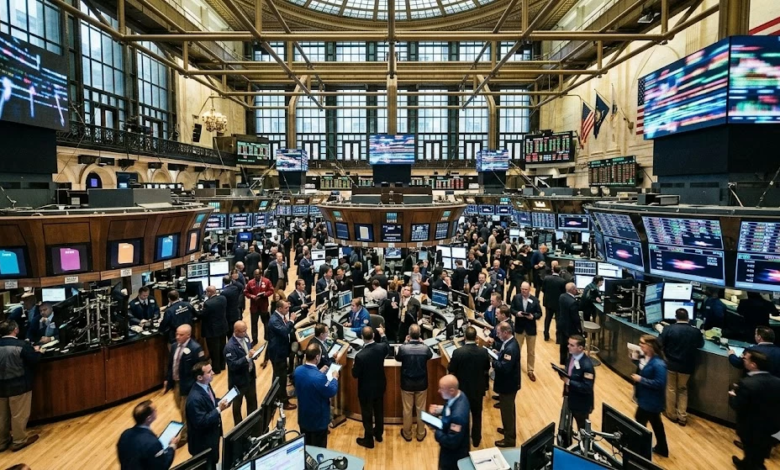

US stocks fell amid inflation fears
Global financial markets experienced a significant tremor as US stocks declined at the start of trading today , amid growing concerns about escalating inflationary pressures. This anxiety stems primarily from the continued rise in global oil prices, a factor that has long played a crucial role in shaping monetary policy. This increase in energy costs could prompt the US Federal Reserve to maintain high interest rates for an extended period, dampening investor appetite for risk and impacting capital flows.
Index performance: Dow Jones, S&P 500, and Nasdaq
On a daily basis, the Dow Jones Industrial Average fell 0.75%, or 337 points, to 45,887. The S&P 500 declined 0.95% to 6,564, and the Nasdaq Composite dropped 1.15% to 21,905. The technology sector was not immune to the losses, with Micron Technology shares plunging 7.72% to $425.93, despite the chipmaker reporting financial results that exceeded analysts' estimates, reflecting the general market anxiety.
Historical context and the impact of oil prices
Historically, oil prices are closely linked to inflation rates. During periods of geopolitical crisis, production and transportation costs rise, directly impacting the prices of goods and services. This context explains the extreme caution currently adopted by the US Federal Reserve, which seeks to avoid repeating past mistakes of hastily cutting interest rates before fully controlling inflation. This justifies the move towards tighter monetary policies to ensure macroeconomic stability.
The repercussions of the developments and the US Federal Reserve's decision
In a related development, the US Federal Reserve today kept its benchmark overnight interest rate unchanged in a range of 3.50% to 3.75%. The Fed indicated that the impact of ongoing developments in the Middle East on the US economy remains "uncertain," with geopolitical tensions contributing to supply chain disruptions. The decision to hold the rate steady was made by a vote of 11 to 1, with the dissenting vote coming from Councilman Stephen Miran, who had advocated for a 25-basis-point cut.
Uncertainty and economic indicators
The US Federal Reserve confirmed in its statement that uncertainty surrounding the economic outlook remains "high," emphasizing that it is closely monitoring risks to price stability and maximum employment. The Fed explained that available indicators suggest economic activity continued to expand at a "solid pace." Regarding employment, the statement noted that job gains remained modest, while the unemployment rate showed little change in recent months.
Expected impact of future monetary policies
In the long term, the Federal Reserve has revealed substantial updates to its economic projections, with new estimates indicating the bank is moving towards enacting only one interest rate cut during 2026, followed by another single cut during 2027. This hawkish path has broad implications; domestically it will lead to continued higher borrowing costs for businesses and individuals, and regionally and internationally it will strengthen the US dollar, putting additional pressure on emerging market currencies and increasing the burden of servicing their external debt.