Venezuela releases political prisoners under US pressure after Maduro's arrest

The Venezuelan government announced on Monday the release of 116 political prisoners, a move that comes as a direct response to mounting pressure from US President Donald Trump, following the dramatic developments in the country recently, which included the arrest of President Nicolas Maduro.
The announcement came from the Venezuelan Ministry of Prisons, which confirmed that those released had been detained on charges related to disrupting the constitutional order and undermining national stability. The ministry indicated that this step is part of a "comprehensive review" of cases, initiated voluntarily by Maduro before his arrest and currently being continued by interim President Delcy Rodríguez, in an effort to adopt a policy focused on justice and dialogue.
Conflicting figures and legal concerns
Despite the government's announcement of the release of 116 individuals, the NGO Foro Penale, which monitors cases of political prisoners, questioned the accuracy of these figures. The organization reported that it had verified the release of only 24 prisoners, including two Italian citizens. Meanwhile, estimates by Agence France-Presse, based on data from the opposition and civil society organizations, indicate that the actual number of those released since last Thursday is closer to 50, leaving a significant gap between the official account and the reality on the ground.
Political context: The post-Maduro arrest phase
These releases are of exceptional importance given the sensitive timing Venezuela is currently experiencing. Following the operation that led to Nicolás Maduro's arrest on January 3, the country entered a critical transitional phase under the watchful eye of the US administration. Observers believe that these swift concessions by Caracas reflect the extent of US President Donald Trump's influence over the current Venezuelan situation, as he previously declared that Venezuela was "in his hands," thus placing the interim government under a real test of its ability to implement international demands.
International dimensions and human suffering
Internationally, these steps were met with cautious optimism, with Italian Prime Minister Giorgia Meloni praising the release of her citizens Alberto Trentini and Mario Borloo, describing cooperation with Venezuelan authorities as "constructive." However, human rights organizations continue to sound the alarm, estimating that between 800 and 1,200 political prisoners remain in detention.
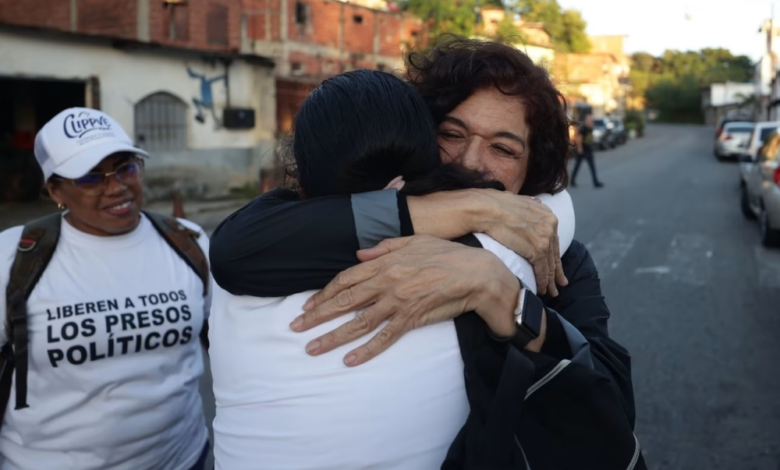
On the ground, the human suffering is palpable outside Rodeo 1 prison, where dozens of families continue their open-ended sit-in 30 kilometers from the capital, Caracas. The families anxiously await any news of their loved ones, amidst growing frustration over the transfer of some released prisoners through secret exits without allowing them to meet their families immediately upon release. This only exacerbates the tension and anticipation on the streets of Venezuela.