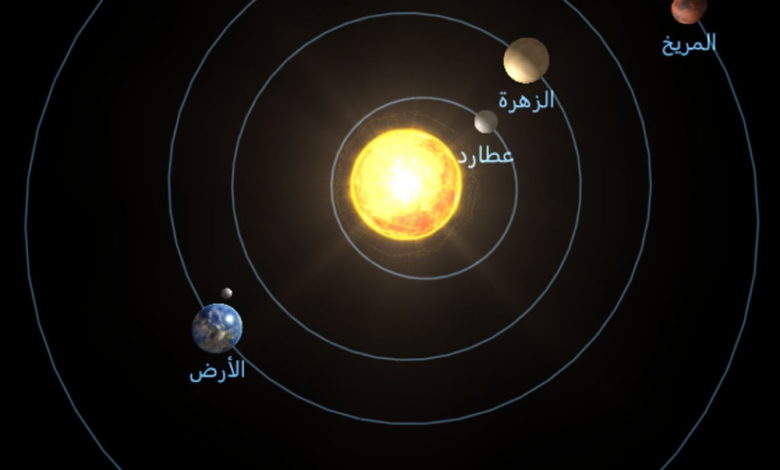

The Jeddah Astronomical Society, through its president, Engineer Majid Abu Zahra, announced a significant astronomical event that will occur in the solar system on Thursday, January 22, 2026. Venus will reach its aphelion, the point in its annual orbit farthest from the sun. This event confirms the accuracy of astronomical calculations and the regularity of planetary motion, although the phenomenon will not be visible to the naked eye.
Details of Venus's apogee phenomenon
Engineer Abu Zahra explained that Venus, the second planet from the Sun, will reach a distance of approximately 109 million kilometers from the Sun on this date. Although Venus's orbit is the closest to a circular path of any planet in the solar system, it is not a perfect circle, meaning it passes through two key points during its orbit: perihelion (closest to the Sun) and aphelion (farthest from the Sun).
Astronomical context: Venus's unique orbit
From a scientific and historical perspective, Venus is characterized by an extremely low orbital eccentricity, approaching zero. This results in a very small difference between its aphelion and perihelion points compared to other planets like Mars or Mercury. This orbital regularity has been of interest to astronomers since ancient times, as observing Venus's motion has contributed to the formulation and refinement of numerous astronomical theories related to celestial mechanics and Kepler's laws of planetary motion.
Why is it impossible to detect the event?
The Jeddah Astronomical Society confirmed that this event is not observable with the naked eye or with ground-based telescopes. The scientific reason for this is not the planet's distance, but rather its extremely close proximity to the sun in the sky as seen from Earth. At this time, Venus is completely immersed in the sun's intense glare, making any attempt to observe it extremely dangerous to the human eye and technically impossible, as the sun's rays completely obscure any possibility of clearly viewing the planet.
Scientific significance and impact of the event
Although the phenomenon is not visible to the naked eye, it holds immense importance for scientists and astronomical observatories worldwide. The aphelion and perihelion moments are used to update orbital data (ephemeris) with extreme precision, which is vital for calculating the trajectories of spacecraft sent to explore the solar system. These events also remind us of the constant dynamism of the solar system and help scientists study the influence of solar gravity on planets at varying distances, thus enhancing our understanding of the astrophysics that govern our cosmic neighborhood.
Abu Zahra concluded his statement by pointing out that the solar system functions as a precise cosmic clock, and that Venus reaching apogee is part of a natural cycle that has been ongoing for billions of years, reflecting the magnificence of the cosmic structure and the precision of the physical laws that govern it.