Venus and Saturn Conjunction 2026: Date and How to Observe the Astronomical Event

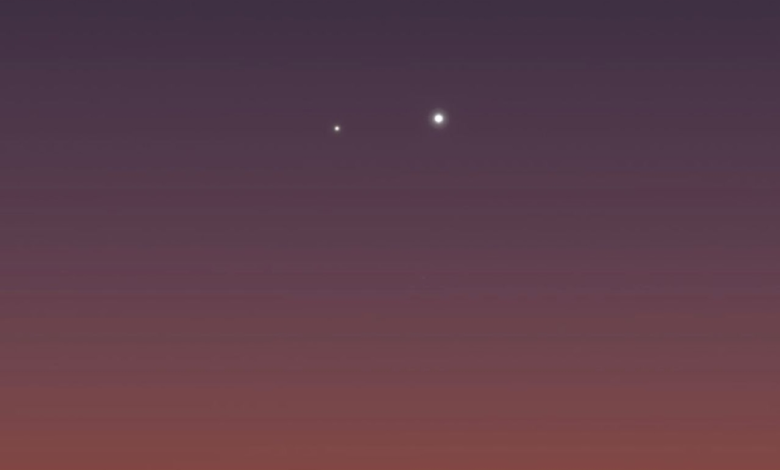
On the evening of Sunday, March 8, 2026, astronomy enthusiasts and celestial observers in the Arab world will turn their attention to the western horizon to observe a remarkable astronomical event. The Jeddah Astronomical Society announced a beautiful planetary conjunction that brings together Venus (the brightest planet in the solar system) and Saturn (the Lord of the Rings), in a scene that can be seen with the naked eye.
Details of the planetary conjunction phenomenon
Engineer Majed Abu Zahra, head of the Jeddah Astronomical Society, explained that this event presents an ideal opportunity for photography and observation, as the two planets will appear remarkably close together, separated by an angular distance of only about one degree, which is roughly twice the apparent diameter of the full moon. Despite this apparent closeness to observers on Earth, the two planets are separated in space by vast distances of hundreds of millions of kilometers, confirming that the phenomenon is purely optical, resulting from the alignment of the planets along a single line of sight.
Scientific background and differences between the two planets
From a scientific perspective, this conjunction offers an educational opportunity to understand the nature of the different planets. Venus will appear exceptionally bright, far surpassing Saturn, due to its rocky nature, its dense clouds that reflect sunlight, and its relative proximity to Earth. In contrast, Saturn will appear as a slightly fainter, golden object, given its status as a gas giant orbiting in the distant reaches of the solar system. This contrast in brightness and color presents observers with a unique celestial spectacle, combining the "jewel of the sky" with the gas giant.
The importance and impact of the event
Conjunctions are of particular importance to the astronomical community and photographers, as they allow for the documentation of planetary movements across the sky and a better understanding of the mechanics of the solar system. Historically, such conjunctions were of great interest to ancient civilizations, who used them to regulate calendars and understand astronomical cycles. Today, these events are an effective way to promote scientific literacy among the general public and encourage young people to take an interest in space science and astronomy, since observing them does not require complex equipment.
Tips for observing and photographing conjunctions
For the best viewing experience, experts recommend looking towards the western horizon about 20 to 40 minutes after sunset, when the evening twilight begins to fade. It's best to be in an open area free from visual obstructions such as tall buildings, and to avoid light pollution as much as possible. Using binoculars is also recommended to view both planets in a single field of view. For photographers, a tripod is advised to ensure camera stability and capture clear images of this celestial conjunction.