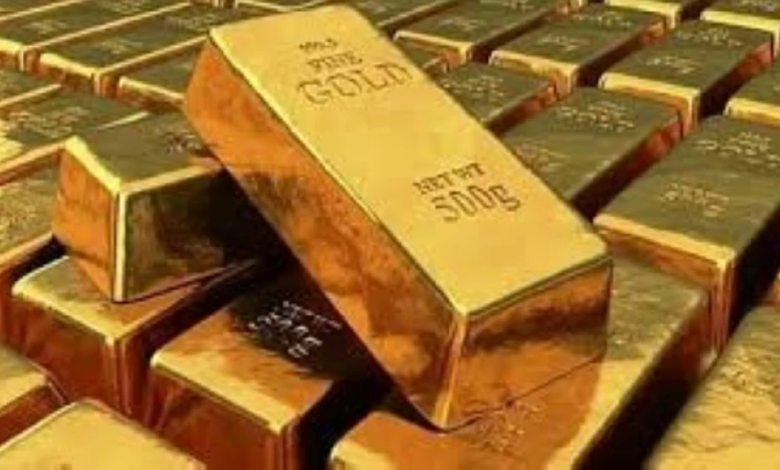

Gold prices continued their strong upward journey in global markets, supported by heavy investment flows towards safe-haven assets, at a time when economic circles are awaiting crucial US jobs data that will outline the Federal Reserve’s monetary policy in the coming period.
Record performance for precious metals
In a notable development reflecting the shifting risk appetite in the markets, spot gold rose 0.8% to $4,485.39 per ounce, extending gains after a nearly 3% jump in the previous session. U.S. gold futures for February delivery followed suit, rising 1% to settle at $4,496.10.
The surge wasn't limited to gold; other precious metals also saw record gains. Silver soared in spot trading, rising 5.4% to $80.68 an ounce. In the industrial metals sector, platinum jumped 7.2% to $2,435.20 an ounce, while palladium climbed 5.9% to $1,821.68 an ounce.
Watch the Federal Reserve data and its impact
US jobs data is of paramount importance at this time, as investors consider it the primary indicator of interest rate expectations. Historically, there has been an inverse relationship between interest rates and gold; higher interest rates increase the opportunity cost of holding gold, which does not generate returns, thus putting downward pressure on its price. Conversely, any signs of a slowing labor market could prompt the Federal Reserve to adopt a more accommodative monetary policy, providing a significant boost to the precious metal.
Gold as a safe haven in times of uncertainty
This surge in demand for gold comes amid a global economic and geopolitical context that is driving investors to seek safety. Historically, gold has been known as a "store of value," with individuals, institutions, and nations turning to it during periods of high inflation, sharp currency market fluctuations, and geopolitical tensions. This traditional role makes gold the preferred asset for hedging against potential risks that could threaten the stability of traditional financial markets such as stocks and bonds.
A look at industrial minerals
The significant rise in silver, platinum, and palladium prices also indicates a convergence of safe-haven investment factors and industrial demand. These metals are used extensively in the technology sector, electric vehicles, and clean energy. Therefore, their surge reflects a dual optimism: firstly, their status as precious metals that track gold's movements, and secondly, the expectation of continued global industrial demand despite current economic challenges.