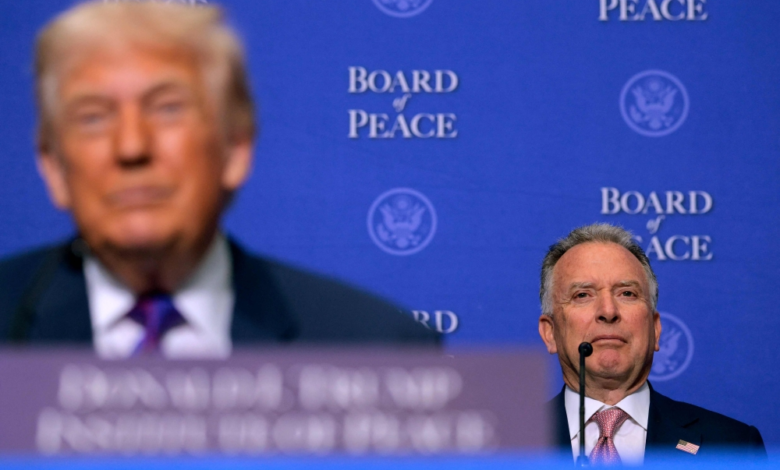
US Special Envoy Steve Wittkopf revealed questions President Donald Trump is asking about why Iran maintains its current stance and has not yet "surrendered," despite the immense military pressure Washington is exerting in the region. These remarks come at a critical juncture in relations between the two countries, teetering between military escalation and diplomatic efforts in Geneva.
Trump's questions and the military buildup
In an interview with Lara Trump on Fox News, Witkoff explained that the US president is perplexed by Tehran's intransigence, especially after the stern warnings of dire consequences should a new nuclear agreement fail. The envoy noted that Washington has deployed a naval strike force, including two aircraft carriers and various warships, to exert maximum pressure.
Witkoff quoted Trump as saying, "Why, under this pressure and with all this overwhelming naval power there, haven't they come to us and declared that they don't want a nuclear weapon?" The envoy added that he didn't want to use the word "frustrated" to describe the president's feelings, given that he had many options, but he was "surprised" that the Iranian leadership hadn't yet raised the white flag.
Strategic meeting with the Shah's son
In a significant development with profound political implications, Witkopf confirmed that he met with Reza Pahlavi, the son of the former Shah of Iran, at the direct instruction of President Trump. Pahlavi resides in the United States and has not returned to his country since the 1979 Islamic Revolution. This move coincides with Pahlavi's statements in Munich, in which he expressed his willingness to lead a "democratic, secular future" for Iran, aligning with Trump's previous suggestions that regime change might be the best option, thus adding a new political pressure point to the negotiating table.
A race against time in Geneva
On the diplomatic front, a second round of talks between the United States and Iran is underway in Geneva, under the auspices of Oman, which is playing a historic mediating role to bridge the gaps and prevent a slide into open military confrontation. Iranian Foreign Minister Abbas Araqchi stated that a draft agreement proposal would be ready within a few days, while President Trump has given Tehran a 15-day deadline to resolve its position on its nuclear program.
Regional context and impact of sanctions
These developments come amid a highly complex regional and international context. Western countries accuse Tehran of seeking to acquire nuclear weapons, an accusation Iran denies, insisting its program is peaceful. Iran is also suffering under harsh economic sanctions that have directly impacted citizens' livelihoods and sparked popular protests last December. Observers believe the current US pressure aims to exploit this dire economic situation to force Tehran to make significant concessions, not only on the nuclear issue but also on its regional influence, making the coming weeks crucial in shaping the future of the Middle East.