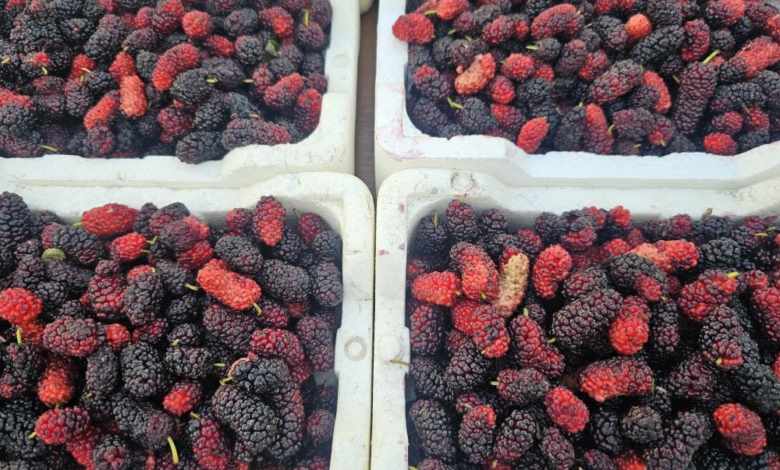

The Eastern Province branch of the Ministry of Environment, Water and Agriculture recorded a yield of 5.26 kilograms per square meter of blackberries grown in greenhouses during the spring season, using grafting techniques. This aims to reduce reliance on imports and enhance self-sufficiency and food security.
Blackberry cultivation is experiencing rapid expansion, driven by technological advancements and the diversification of modern varieties to meet local demand. This trend seeks to improve production quality and provide high-value, high-energy-value crops to the market.
Multi-varietal fruit
The Director of the Agriculture Department at the Ministry of Environment, Water and Agriculture's Eastern Province branch, Engineer Waleed Al-Shuwaired, explained that mulberries are among spring fruits, available in numerous varieties and colors.
He noted that local varieties include sweet white mulberries, shades ranging from red to dark red, black mulberries rich in antioxidants, and similar purple mulberries.
Al-Shuwaired pointed out that the fruit's flavor gradually changes from tart to sweet as it ripens. He emphasized that these characteristics make mulberries a beloved and sought-after fruit for all age groups. He added that farmers utilize grafting techniques to obtain mulberries of different colors and sizes on a single tree.
He also revealed the introduction of heat- and drought-tolerant varieties, such as the Turkish mulberry, which is distinguished by its abundant yield and sweet taste.
Spring crop supports the economy
Engineer Al-Shuwaired discussed the widespread cultivation of mulberry trees in geographically dispersed areas within the Kingdom with suitable climates. These cultivations are concentrated in the Eastern Province, specifically Qatif and Al-Ahsa, as well as Al-Baha, Asir, and parts of Riyadh and Qassim, in addition to greenhouse cultivation.
He confirmed that spring is the primary season for planting and harvesting mulberries in Saudi Arabia, lasting no more than a month and a half. The flowering and fruiting season begins in mid-March and continues until early May.
Al-Shuwaired emphasized that mulberries represent a promising economic crop that reduces reliance on imports and supports agritourism. He considered the successful cultivation of mulberries in open fields and greenhouses to be a direct contribution to diversifying food sources within the Kingdom's agricultural development strategies.
He stated that harvesting mulberries requires precise agricultural practices that focus on achieving full color and easy detachment from the stem. Farmers prefer to harvest the crop in the early morning hours during March and April after the dew has evaporated to preserve the delicate fruit's freshness.
Challenges of growing berries
He added that mulberry fields face ongoing agricultural challenges due to whiteflies, spider mites, and mulberry moths, which threaten the crop. This necessitates early agricultural intervention through preventative measures that ensure the protection of the trees during flowering and fruiting.
He explained that control measures begin with the natural planting of repellent plants such as mint, basil, and onions around the bushes. This step is supported by covering the plants with special netting that prevents small insects from entering the fields.
Moderate irrigation and good drainage play a crucial role in preventing the accumulation of moisture that attracts pests. Regular pruning of branches contributes to tree ventilation and reduces insect breeding grounds.
Protecting the fruit requires periodic inspection to detect early infestations and remove them immediately before they spread throughout the crop. Environmentally safe organic pesticides such as garlic solution and neem oil are used to effectively repel insects.
Harvesting mulberries is an economic and nutritional endeavor that depends on continuous care and regular pest monitoring. Sound agricultural practices ensure that a bountiful and clean crop reaches the end consumer at the highest quality.