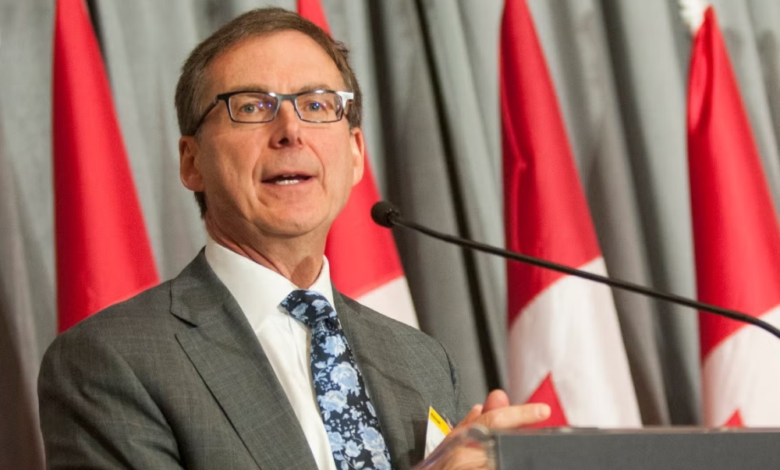
Tiff Macklem, the governor of the Bank of Canada, issued stark warnings about the future of the global economy, declaring that the era of rules-based trade relations with the United States is "over." These remarks reflect the deepening rift between Ottawa and Washington, echoing concerns that the global order is fracturing as a result of the protectionist policies pursued by the US administration.
The end of the era of open trade
In a striking statement, McCallum asserted that "it is abundantly clear that the era of open, rules-based trade with the United States is over." This statement is not merely a description of the situation, but rather a declaration of a new phase of economic uncertainty gripping North America. These remarks come just days after Mark Carney, the former governor of the Bank of Canada and the Bank of England, warned US President Donald Trump that his economic approach has created a serious "fracture" in the structure of the global economic order that has prevailed for decades.
Context of the clash in Davos
The roots of the recent escalation can be traced back to the World Economic Forum in Davos, where Carney called on middle powers to unite against what he termed "hegemonic" forces, an implicit reference to the unilateral policies of the United States. This stance provoked a sharp rebuke from US President Donald Trump, who responded from the same podium, saying, "Canada is only alive because of the United States. Remember that, Mark, next time you make a statement." This exchange reflects a radical shift in the rhetoric between the two traditional allies.
Background to the tensions: The Chinese paper and tariffs
The war of words didn't stop there; it escalated to direct economic threats. Trump renewed his threat to impose punitive tariffs of up to 100% on Canadian imports if Ottawa proceeded with a new trade agreement with China. This move would place immense pressure on the Canadian economy, which is heavily reliant on the American market, with the vast majority of its exports going to its southern neighbor.
Potential economic repercussions for the global system
Economically, this tension carries significant risks that extend far beyond Canada's borders. The unraveling of the "rules-based order" would mean a return to the law of the jungle in economics, where stronger nations dictate terms outside the mechanisms of the World Trade Organization. For Canada, this could lead to sharp fluctuations in the Canadian dollar's exchange rate, a rise in imported inflation, and disruption to integrated supply chains between the two countries, particularly in vital sectors such as automobiles and energy.
Although Carney described a recent phone call between the two sides as "good," signs on the ground indicate that the relationship between the two countries is at a critical historical juncture that could reshape economic alliances in the Western Hemisphere.