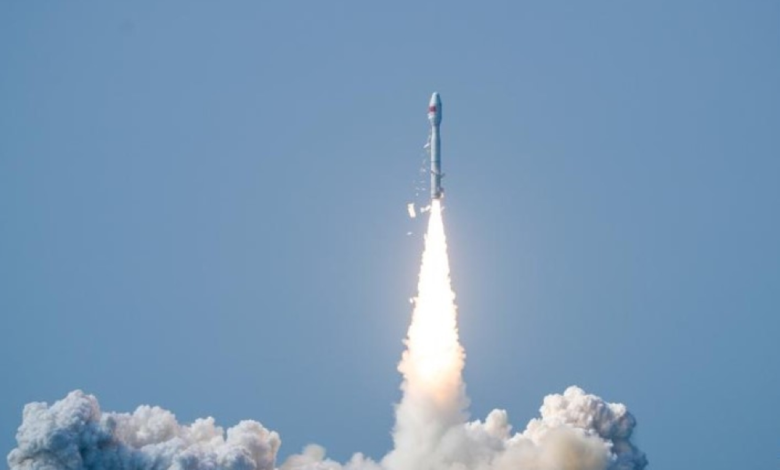

In a move that underscores the accelerating pace of its ambitious space program, China today announced the successful launch of seven new satellites into space, using a sea-based launch platform, reflecting the development of its capabilities in diversifying its means of accessing Earth orbits.
Details of the naval launch operation
Official reports, including those from Xinhua News Agency, stated that the launch was successful, utilizing a Smart Dragon-3 carrier rocket launched from a floating platform off the coast of Yangjiang City in Guangdong Province, southern China. The Taiyuan Satellite Launch Center oversaw the precise mission, confirming that all seven satellites entered their planned orbits with high accuracy.
The importance of Smart Dragon-3 missiles and naval platforms
The Smart Dragon-3 is a commercial solid-fuel rocket designed to meet the growing demand for launching small and medium-sized commercial satellites. Sea-based launches are of significant strategic and technological importance to China; they offer greater flexibility in launch site selection, enabling more efficient and fuel-efficient targeting of specific orbits. Furthermore, sea-based launches mitigate the risks associated with rocket debris, as they take place far from populated areas—a challenge typically posed by launches from inland land-based bases.
General context of the Chinese space program
This launch is the latest in a series of successes for Beijing in recent years, as China seeks to establish itself as a space superpower rivaling the United States and Russia. China's ambitions extend beyond satellite launches to include operating its own space station, Tiangong, and lunar and Mars exploration programs. The increasing reliance on sea-based launches demonstrates China's desire to bolster its commercial space sector and provide low-cost, flexible launch solutions for both domestic and international customers.
Intense space activity
It is worth noting that this launch comes very soon after another successful operation, in which China recently launched the Tiangwei-7 satellite, designed for geographic mapping, from the Jiuquan Satellite Launch Center in the northwest of the country, using a Long March-4B rocket. This rapid succession of launches reflects the high operational capabilities and enormous resources that China dedicates to the space sector, whether for civil, commercial, or strategic purposes.