First supermoon of 2026: The date of the phenomenon and the conjunction of Jupiter

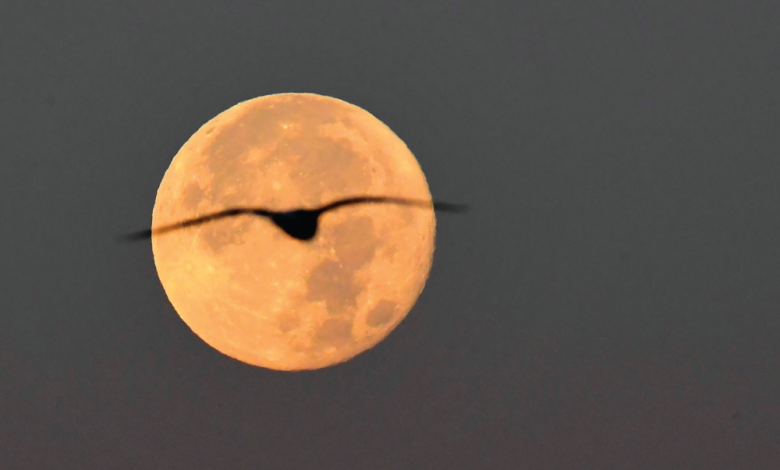
On the evening of Saturday, January 3, 2026, astronomy enthusiasts and naturalists across the Arab world will be turning their gaze to the sky to witness a remarkable astronomical event: the first "supermoon" of the new year. Engineer Majed Abu Zahra, head of the Jeddah Astronomical Society, confirmed that this full moon will appear larger and brighter than usual, with its illumination reaching approximately 99.6%, making it an exceptional spectacle well worth observing and photographing.
What is a supermoon? And why does it happen?
Abu Zahra explained that the term "supermoon" is not a strictly astronomical term, but rather a common one used when a full moon coincides with the moon reaching its perigee, the point in its elliptical orbit closest to Earth. Precise astronomical calculations indicate that on this night, the moon will be approximately 362,312 kilometers from our planet. This relative proximity makes it appear up to 14% larger and about 30% brighter compared to when it is at its farthest point (apogee), although the differences may not be significant to the untrained eye unless compared with photographs.
Timing of completion and accompanying phenomena
The full moon occurs when the moon is at an angle of approximately 180 degrees from the sun. This will happen on Saturday at 1:02 PM Mecca time. As the sun sets that day, the supermoon will rise from the eastern horizon, initially appearing orange or reddish. This coloration is due to atmospheric physics, where particles and dust scatter the blue wavelengths of light, allowing red and orange wavelengths to pass through, before the moon acquires its bright silvery-white hue as it rises higher in the sky.
A beautiful conjunction with Jupiter
What makes this astronomical night special is the coincidence of the supermoon with Jupiter—the giant planet of our solar system—being in optical conjunction with it. Observers will be able to see a bright point of light near the moon, which is Jupiter. Although the two celestial bodies appear close together in the sky, they are actually separated by millions of kilometers in the vastness of space. This double spectacle offers an ideal opportunity for astrophotography enthusiasts to capture the two celestial bodies together in a single frame, and even more detail can be seen using small binoculars.
Geophysical effects: Facts and myths
Scientifically, the moon's proximity to Earth is linked to the phenomenon of tides. The head of the Jeddah Astronomical Society confirmed that a supermoon causes what is known as a "perigee tide," where the moon's close gravitational pull, combined with the sun's gravity, amplifies the high tide and low tide more than usual. However, Abu Zahra emphasized that rumors linking the supermoon phenomenon to natural disasters such as earthquakes or volcanic eruptions are unfounded, asserting that scientific evidence and historical records do not establish any causal relationship between the moon's gravitational energy and the Earth's geological activity.
Tips for monitoring and photography
For the best viewing experience, it's recommended to observe the moon at moonrise or moonset, when the "moon illusion" effect occurs. This optical illusion makes the moon appear remarkably large when viewed behind terrestrial features such as buildings, mountains, or trees. These times are ideal for capturing artistic photographs that highlight the magnificence of the phenomenon. It's also best to observe lunar features like craters when the moon is not fully full, as the shadows create a more detailed view.