Air traffic paralyzed in Greece: Technical fault shuts down airports for hours

Air traffic in Greece experienced severe disruption and temporary paralysis on Sunday, as the Greek Civil Aviation Authority announced the cancellation of a large number of flights and the postponement of others at several major airports, as a result of a sudden and unprecedented technical malfunction that caused radio frequencies to be cut off in the country's airspace.
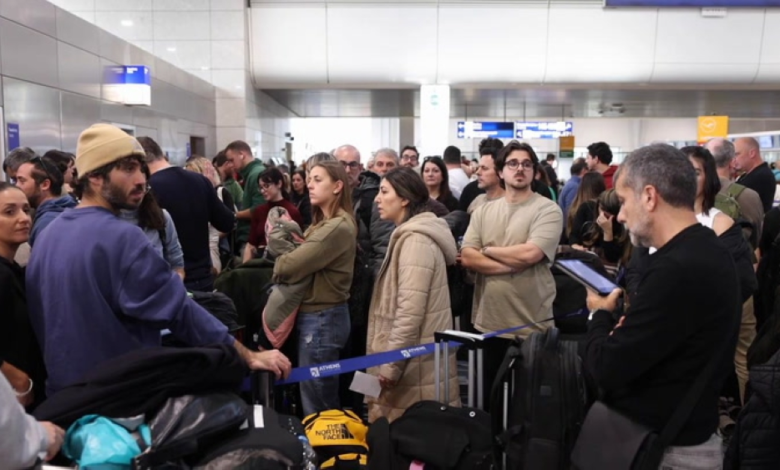
The crisis began to manifest itself clearly at Eleftherios Venizelos International Airport in Athens, the country's main gateway, where large numbers of passengers crowded into the departure halls, queuing in long lines amidst widespread anxiety and anticipation due to the extensive disruption to domestic and international flight schedules. According to official reports, the radio frequency outage was detected at 7:00 AM GMT, leading to a complete halt in all takeoffs and landings for over two hours.
The importance of the aviation sector and the impact of disruptions
This incident comes at a sensitive time for the Greek aviation sector. Data indicates that Athens Airport handled approximately 31.6 million passengers during the first 11 months of 2025, reflecting the Greek economy's heavy reliance on tourism and travel. Greece is one of the most important tourist destinations in the Mediterranean, and any disruption to its transportation infrastructure directly impacts its tourism reputation and air connectivity between Europe and the Middle East.
In response to the crisis, aviation authorities were forced to divert most flights bound for Greek airports to neighboring Turkish airports, with the diversions lasting up to three hours, according to Greek state broadcaster ERT. This measure reflects international protocols followed in air emergencies to ensure the safety of passengers and aircraft, despite the traditional regional rivalry between the two countries.
Warnings about obsolescence of equipment
The incident did not pass without raising serious questions about the efficiency of the technical infrastructure at Greek airports. Panagiotis Psaros, head of the Greek air traffic controllers' union, described the incident as "very serious," pointing the finger at the airport's equipment, which he described as "outdated." This statement highlights broader challenges facing the aviation sector in Europe and the world, related to the need to modernize communication and air navigation systems to keep pace with the ever-increasing number of passengers and flights.
Flight operations began gradually returning to normal from 11:00 GMT after technical teams brought the fault under control. However, the disruption may cause lingering delays to flights scheduled for the following day, so passengers should check with their airlines for updated flight information.