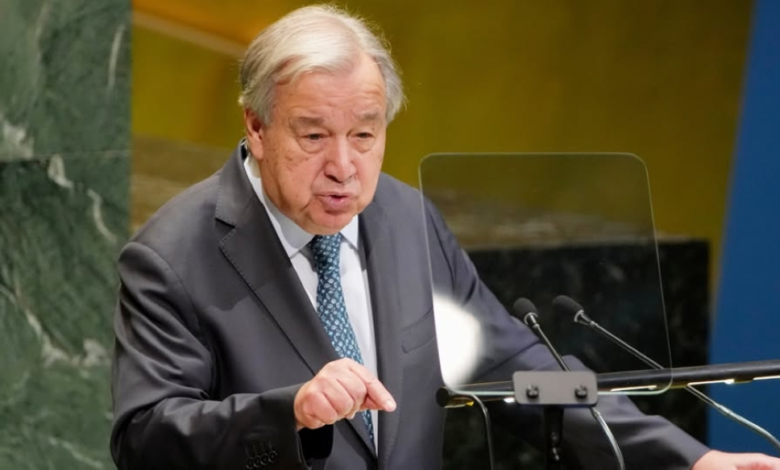

In a strongly worded warning reflecting the gravity of the current situation, UN Secretary-General António Guterres issued an urgent and decisive appeal to both the United States and Russia, urging them to return to the negotiating table to sign a new nuclear arms control agreement. This appeal comes on the eve of the expiration of the New START Treaty, the last remaining framework for controlling the nuclear arsenals of the two superpowers, placing the world before what Guterres described as a "critical moment for international peace and security.".
With the treaty's expiration on Thursday, Moscow and Washington are officially freed from the strict restrictions that were imposed on their nuclear arsenals, opening the door to worrying possibilities of a new, unrestrained arms race.
A world without nuclear restrictions for the first time in decades
In an official statement, Guterres expressed his deep concern, saying, “For the first time in more than half a century, we are facing a world without any binding limits on the strategic nuclear arsenals of the Russian Federation and the United States of America.” He emphasized that the New START Treaty, along with previous arms control agreements, had contributed significantly to strengthening the security of nations and sparing the world the horrors of nuclear war.
The Secretary-General added, warning of the critical timing of this legal vacuum: “This termination of decades of achievements could not come at a worse time, as the risk of the use of a nuclear weapon is at its highest level in decades,” stressing the need to agree on an alternative framework without delay.
Historical background: The collapse of the last bastions of censorship
To understand the gravity of the situation, one must consider the historical context of the New START Treaty, signed in Prague in 2010 by then-Presidents Barack Obama and Dmitry Medvedev. Entering into force in 2011 as the successor to START I, the treaty aimed to reduce deployed strategic nuclear warheads to 1,550 for each side—a reduction of approximately 30% from the previous limit imposed in 2002—and to limit the number of ballistic missiles and bombers to 700.
The treaty was a cornerstone of global strategic security, not only because it set a ceiling on armaments, but also because it included rigorous verification mechanisms that allowed each party to conduct on-site inspections (18 inspections per year) and exchange data on nuclear forces, thus enhancing transparency and mutual trust.
The consequences of a lack of agreement: worrying scenarios
The termination of the treaty without an immediate alternative would have serious repercussions at the local, regional, and international levels:
- On the security front: The absence of inspection mechanisms – which were already suspended during the coronavirus pandemic and have not been resumed – means a lack of transparency, which increases the risk of miscalculation or misjudgment that could lead to an unintended nuclear conflict.
- A new arms race: Russia and the United States currently control more than 80% of the world's nuclear warheads. The absence of restrictions could push both sides to modernize and expand their arsenals, potentially drawing other nuclear powers like China into a three-way arms race, thus threatening global strategic stability.
- Economic impact: The shift towards an open arms race will drain huge budgets that could be directed towards development, as the maintenance and development of nuclear weapons require enormous financial resources.
In a related context, media reports quoted the Russian Foreign Ministry's statement confirming that "the parties to the New START Treaty are no longer bound by any mutual pledges or declarations within the framework of the treaty," thus reinforcing the state of ambiguity that prevails in the international scene.