Kabul bombings and border clashes: Escalation between the Taliban and Pakistan

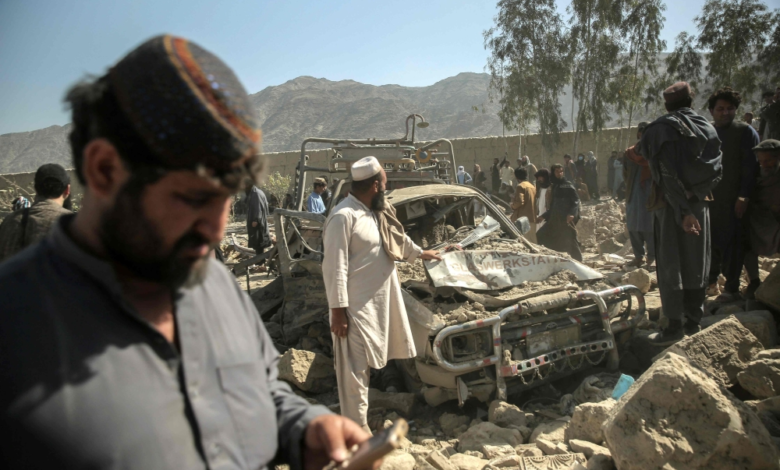

The Afghan capital, Kabul, witnessed a dangerous security development in the early hours of Friday morning, represented by a series of loud explosions that shook the city, amid heavy military aircraft activity and the sound of heavy gunfire, following an unprecedented military escalation on the border between the Taliban government forces and the Pakistani army.
Details of the night of terror in Kabul
Local sources and eyewitnesses reported hearing a massive explosion at 1:50 a.m. local time (21:20 GMT), coinciding with the sighting of at least one fighter jet flying over the capital. This was followed by a series of secondary explosions and gunfire that lasted for approximately 40 minutes.
News agencies quoted a resident of one of the affected areas as saying that the city was hit by approximately eight explosions. He explained, "The explosions started far away, but the subsequent strikes were so close that they violently shook the walls of houses. The sound of fighter jets was clearly audible after each strike." Gunfire continued in central Kabul until 2:30 a.m., causing widespread panic among residents.
Context of the escalation: Deadly border clashes
The events in Kabul cannot be separated from the escalating tensions on the Afghan-Pakistani border. These explosions came just hours after the Taliban government announced a large-scale military offensive targeting Pakistani army positions, in retaliation for earlier airstrikes carried out by Islamabad inside Afghan territory.
Taliban spokesman Zabihullah Mujahid stated via the X platform that their forces killed and captured a number of Pakistani soldiers during the attack on border posts. In response, the Pakistani Ministry of Information described the attack as "unprovoked firing" targeting Khyber Pakhtunkhwa province, vowing an "immediate and effective" response.
Background of the conflict and its regional effects
This renewed tension stems from complex historical and security issues between the two neighbors. Pakistan frequently accuses the Taliban government of providing safe havens for militants of the banned Pakistani Taliban, who launch attacks deep inside Pakistan from Afghan territory. Kabul consistently denies these accusations, emphasizing its commitment to not allowing its territory to be used against any neighboring country.
This escalation carries serious regional implications, as the exchange of attacks and airstrikes is feared to lead to an open confrontation that could further destabilize the already fragile region. This development also presents the international community with new challenges in dealing with the Taliban government and maintaining security along the Durand Line, the demarcation line between the two countries, which has long been a major point of contention in bilateral relations.
Observers believe that the exchange of airstrikes and ground clashes represent a qualitative shift in the rules of engagement between the two sides, which portends the possibility of the conflict expanding to include other areas if the situation is not contained diplomatically as soon as possible.