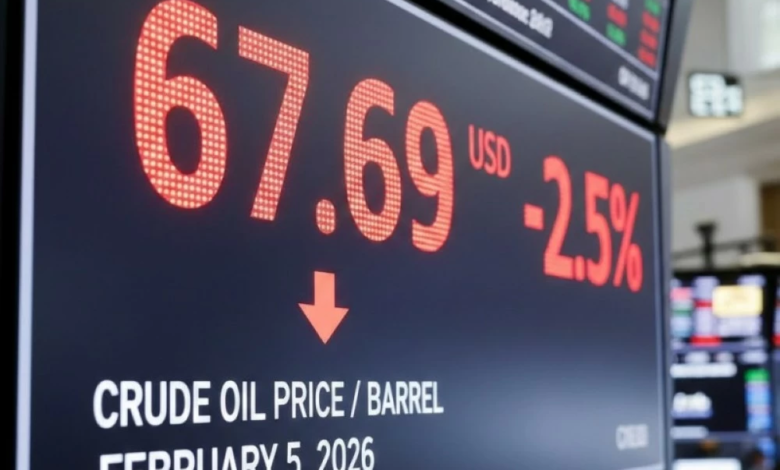

Global oil prices deepened their losses significantly during trading on Thursday, registering a decline exceeding 2.5%, influenced by a wave of cautious optimism that swept through global financial markets. This sharp drop coincides with investors and traders awaiting the start of anticipated diplomatic talks between the United States and the Islamic Republic of Iran, scheduled to be held on Friday in the Omani capital, Muscat.
Details of price declines in global markets
In the language of numbers that reflected the market’s immediate response to these political developments, Brent crude futures for April delivery fell by 2.55%, with the barrel losing about $1.77 of its value, settling at $67.69 per barrel, after recording a drop earlier in the session to $67.52.
In parallel, West Texas Intermediate (WTI) crude oil futures for March delivery fell by 2.60%, losing $1.68 to settle at $63.47 per barrel, after touching a low of $63.23 during the session.
Oman's role and the importance of geopolitical talks
These talks are of paramount strategic importance given Oman's historical role as a trusted mediator in the region, with Muscat having previously succeeded in bridging divides on contentious issues. This round of negotiations comes at a highly critical juncture, as both sides seek an agreement to end the escalating tensions recently witnessed in the Arabian Gulf region, which have cast a dark shadow over the security of global energy supplies.
Analysts believe that simply announcing these meetings and discussing the Iranian nuclear file and outstanding contentious issues has directly contributed to reducing what is known as the "risk premium" that was added to oil prices in anticipation of any supply disruption or outbreak of military confrontation.
The impact of tensions on shipping and energy
The region experiencing the tensions is a vital artery for the global economy, as a significant portion of the world's oil exports pass through the Strait of Hormuz. Therefore, any indication of diplomatic de-escalation is immediately reflected in lower prices, as investors are reassured that supplies will continue uninterrupted. Despite initial reports suggesting the talks might have stalled, the two countries' reaffirmation of their commitment to continuing negotiations has restored relative calm to the markets.
However, markets remain on high alert, as investors closely monitor these negotiations, which have been described as "fragile," especially in light of the tough statements from US President Donald Trump and his determination to carry out his threats if the diplomatic track fails, leaving the scene open to all possibilities in the coming days.