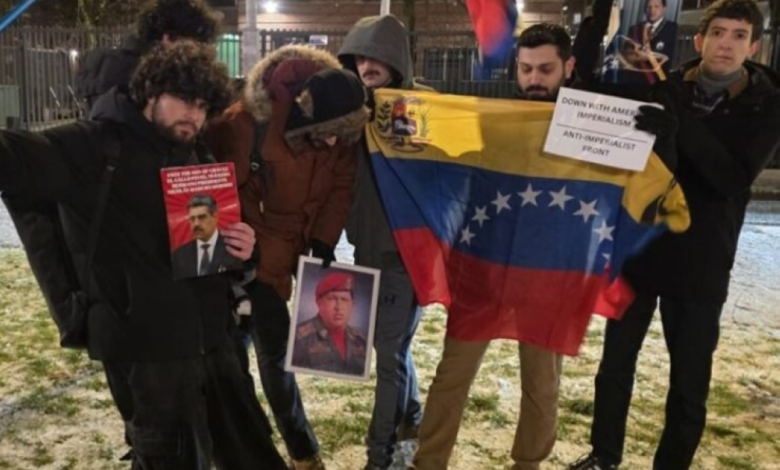
Protests in Madrid and Amsterdam condemning Maduro's arrest and US intervention

The European capitals of Madrid and Amsterdam witnessed a wave of angry protests on Sunday morning, as hundreds of demonstrators gathered to express their outright rejection of what they described as "imperialist aggression," following the US military operation that led to the arrest of Venezuelan President Nicolás Maduro. These popular movements come as a direct reaction to the dramatic developments unfolding on the international stage, amid fears of the repercussions of this escalation on the stability of Latin America.
Slogans condemning US policies
In the Spanish capital, Madrid, nearly a thousand protesters gathered in front of the US embassy, holding signs and banners attacking US President Donald Trump. One prominent banner depicted Trump swallowing a bowl of oil painted in the colors of the Venezuelan flag, a symbolic reference to the economic motives behind the military intervention. The protesters chanted slogans such as “Trump is an aggressor” and “No to imperialist aggression against Venezuela,” with a notable presence of supporters from the left-wing Podemos party and the Spanish Communist Party, who waved Venezuelan flags in solidarity with Caracas.
Background to the conflict and Venezuelan oil
These events take on a profound strategic dimension given the historically strained relations between Washington and Caracas. Venezuela possesses the world's largest proven oil reserves, making it a constant focus of attention for major powers. President Donald Trump's statements have only reinforced the protesters' fears, as he explicitly declared that the United States would "manage" Venezuela during a transitional period, indicating that American companies would play a role in exploiting its oil resources—a move analysts interpreted as a clear return to policies of direct resource control.
Spain's position and international law
On the official political level, Spanish Prime Minister Pedro Sánchez adopted a cautious yet critical stance. While his country was hosting Edmundo González Urrutia, the Venezuelan opposition candidate, Sánchez criticized the military operation, describing it as an “intervention that violates international law.” He warned that such unilateral actions could threaten the stability of the entire region, calling instead for a just transition based on political dialogue, not military force.
Protests spread across Europe
The reactions weren't limited to Spain; they extended to the Netherlands, where hundreds demonstrated in front of the US consulate in Amsterdam. Protesters held signs with powerful messages such as "Stop the killing for oil" and "Stop Trump's fossil fuel army," demanding an end to what they considered the military exploitation of political crises. This popular movement in Europe reveals a clear division in Western public opinion regarding the US approach to the Venezuelan issue, especially given that Maduro is currently imprisoned in New York awaiting trial on drug trafficking charges—charges the US Department of Justice has long leveled against the Venezuelan regime as part of its ongoing pressure campaign.