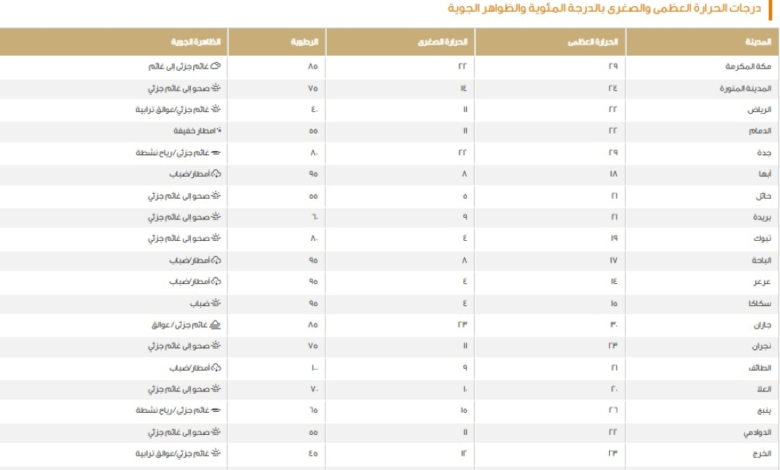

The National Center for Meteorology announced on Monday the details of the maximum temperatures recorded in various regions and cities of the Kingdom. The data showed a noticeable variation in weather conditions between coastal areas, mountainous regions, and northern areas. Dammam recorded 22 degrees Celsius, while Jazan and Al-Qunfudhah topped the list with the highest temperatures, and As-Soudah recorded the lowest maximum temperature.
List of maximum temperatures in the cities of the Kingdom
According to the report issued by the center, the maximum temperatures recorded today were as follows:
- Dammam: 22 degrees Celsius.
- Mecca: 29 degrees Celsius.
- Medina: 24 degrees Celsius.
- Riyadh: 22 degrees Celsius.
- Jeddah: 29 degrees Celsius.
- Abha: 18 degrees Celsius.
- Hail: 21 degrees Celsius.
- Buraidah: 21 degrees Celsius.
- Tabuk: 19 degrees Celsius.
- The courtyard: 17 degrees Celsius.
- Arar: 14 degrees Celsius.
- Sakaka: 15 degrees Celsius.
- Jazan: 30 degrees Celsius.
- Najran: 23 degrees Celsius.
- Taif: 21 degrees Celsius.
- Al-Ula: 20 degrees Celsius.
- Yanbu: 26 degrees Celsius.
- Al-Dawadmi: 22 degrees Celsius.
- Al-Kharj: 23 degrees Celsius.
- Wadi Al-Dawasir: 25 degrees Celsius.
- Sharurah: 29 degrees Celsius.
- Combined: 19 degrees Celsius.
- Face: 27 degrees Celsius.
- Rafha: 18 degrees Celsius.
- Al Qurayyat: 17 degrees Celsius.
- Tarif: 13 degrees Celsius.
- Al Qunfudhah: 30 degrees Celsius.
- Al-Ahsa: 20 degrees Celsius.
- Hafar Al-Batin: 16 degrees Celsius.
- Bisha: 24 degrees Celsius.
- Al-Sawda: 11 degrees Celsius.
- Rawdat Al-Tanhat: 15 degrees Celsius.
- Al-Dahna desert: 14 degrees Celsius.
- Al-Saman: 15 degrees Celsius.
Climatic and geographical diversity in the Kingdom
These figures reflect the great geographical diversity of Saudi Arabia, which directly affects the prevailing climate. While northern regions such as Tarif and Arar experience a noticeable drop in temperatures, reaching 13 and 14 degrees Celsius, due to the influence of cold air masses coming from the north, southern coastal regions such as Jazan and Al-Qunfudhah maintain warm temperatures reaching 30 degrees Celsius due to their geographical location adjacent to the Red Sea and the influence of relative humidity.
In contrast, mountainous areas such as Al-Soudah (11°C) and Al-Baha (17°C) stand out as destinations characterized by relatively cool weather even during daylight hours, reflecting the nature of the towering mountainous terrain in the Sarawat Mountains.
The role of the National Center for Meteorology and the importance of data
The National Center for Meteorology plays a pivotal role in monitoring and tracking weather conditions in the Kingdom using state-of-the-art weather radar and satellite technologies. This data is of paramount importance to citizens and residents, as it helps in planning daily activities and taking necessary precautions while driving on highways, especially given the ongoing warnings about the possibility of fog formation or surface wind activity in some areas, such as the Eastern Province and the highlands.
This information is also vital to various economic sectors, including agriculture, transportation, and tourism, as farmers and travelers rely on the accuracy of these forecasts to ensure safety and efficiency in their work and travel.