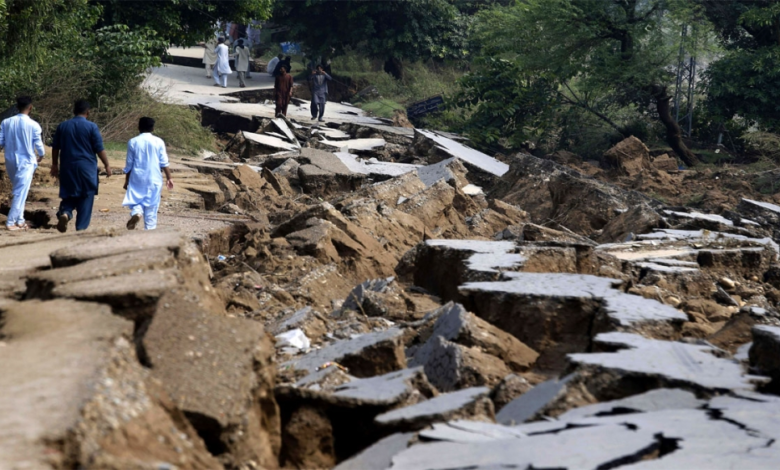
Pakistan earthquake today: A 5.6 magnitude tremor strikes Balochistan and Sindh

Today, the Islamic Republic of Pakistan witnessed a worrying geological event, as an earthquake measuring 5.6 on the Richter scale struck the southwestern province of Balochistan, and its effects extended to parts of the southern Sindh province, causing a state of anticipation and caution among residents and local authorities.
Details of the earthquake and its location
According to official data from the Pakistan Meteorological Department and Geological Survey, the epicenter of the earthquake was precisely located near the city of Khuzdar in Balochistan province. Technical data indicated that the tremor was relatively shallow, with the epicenter only about 13 kilometers below the Earth's surface. Shallow earthquakes are generally more impactful and felt by the population than deep earthquakes because the energy released is closer to the surface.
Field situation and losses
As of the time of this report, there have been no immediate official reports of casualties or injuries among civilians. Local authorities have also not reported any significant material damage to infrastructure or buildings in the affected areas, particularly in and around Khuzdar city. However, emergency and civil defense teams remain on alert to more accurately assess the situation, especially in remote villages where information may be delayed.
Geological background: Why do earthquakes occur so frequently in Pakistan?
Pakistan is a seismically active country due to its complex geographical location; the country lies above the collision zone of two major tectonic plates, the Indian Plate and the Eurasian Plate. This constant collision and immense geological pressure leads to the accumulation of energy in the Earth's layers, which is suddenly released in the form of earthquakes.
Balochistan, the region struck by today's earthquake, is one of the most seismically active areas in the region. Historically, this area has experienced devastating earthquakes, making any seismic activity, even moderate in magnitude like today's 5.6 quake, a matter of close monitoring by experts, for fear of aftershocks or the activation of other fault lines.
The importance of monitoring and safety procedures
The importance of monitoring this earthquake lies in its serving as a constant reminder of the region's geological nature. In such cases, authorities typically urge citizens to exercise caution and stay away from dilapidated buildings in anticipation of aftershocks that may occur in the coming hours or days. Residents are also advised to follow official updates from the meteorological department and not to be swayed by rumors that may circulate during times of crisis.
The National Earthquake Monitoring Center continues to monitor seismic activity in and around the Khuddar region, to provide up-to-date data that helps in making appropriate decisions to protect lives and property.