Launch of the Saudi College of Mining: A strategic step towards achieving Vision 2030

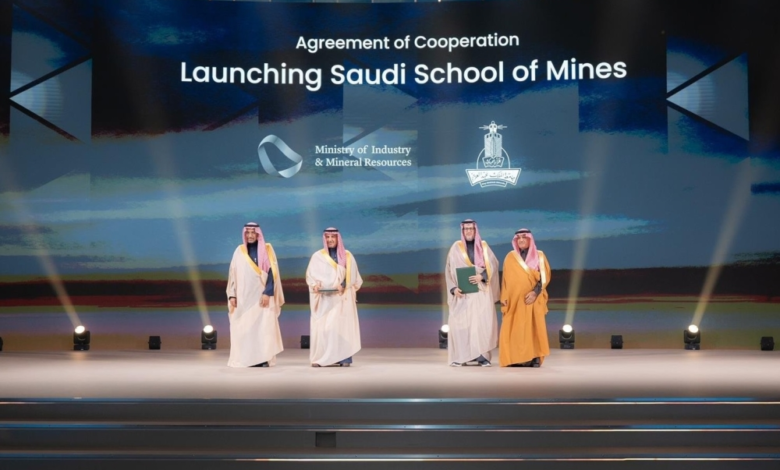
In a strategic move aimed at reshaping specialized education in the Kingdom and the region, the Ministry of Industry and Mineral Resources and King Abdulaziz University signed a landmark cooperation agreement today to establish the “Saudi College of Mining.” This ambitious initiative, which will transform the university’s College of Earth Sciences and Department of Mining Engineering into a world-class academic and research institution, was announced on the sidelines of the fifth edition of the International Mining Conference.
The signing of the agreement was attended by a high-level audience, including His Excellency the Minister of Industry and Mineral Resources, Mr. Bandar bin Ibrahim Al-Khorayef, and His Excellency the Minister of Education, Mr. Yousef bin Abdullah Al-Bunyan. The two sides were represented in the signing by His Excellency the Deputy Minister of Industry for Mining Affairs, Engineer Khalid bin Saleh Al-Mudaifer, and the President of King Abdulaziz University, Dr. Tarif bin Yousef Al-Aama.
A key pillar of Vision 2030
This agreement is of paramount importance within the context of the major economic transformations underway in Saudi Arabia as part of Vision 2030, where the mining sector is considered the third pillar of national industry, alongside oil, gas, and petrochemicals. The Kingdom is working to exploit its vast mineral wealth, valued at trillions of riyals, which necessitates a robust educational infrastructure capable of producing qualified national talent to lead this promising sector.
The importance of the new college is not limited to the local aspect only, but extends to the regional and international dimension, as the global demand for critical minerals needed for the transformation in the field of energy and advanced industries is increasing, which places the Kingdom at the heart of global supply chains, and makes qualifying human competencies an urgent necessity to ensure the sustainability of this leading role.
Global ambition and strategic partnerships
The agreement aims to position the Saudi College of Mining among the top five educational institutions globally in the field of earth sciences and mining. To achieve this ambitious goal, work will commence on:
- Attracting a global academic partner to transfer expertise and localize advanced knowledge.
- A comprehensive restructuring of undergraduate and graduate programs to meet the demands of the rapidly evolving job market.
- Bridging the gap between academic output and the actual needs of major industrial companies.
Investing in human capital
His Excellency the Minister of Industry and Mineral Resources, Mr. Bandar Al-Khorayef, affirmed that this step embodies effective government integration, emphasizing that the true guarantee for the sustainability of the mining sector lies in investing in human capital. He pointed out that the college will play a pivotal role in graduating national leaders who possess the necessary skills to manage mega mining projects, thus enhancing the Kingdom's position as a global hub for minerals.
For his part, His Excellency the Minister of Education, Professor Yousef Al-Bunyan, explained that the college represents a practical application of the “productive education” model, which links educational outcomes to direct investment opportunities. He added that this partnership will contribute to diversifying the national economy and consolidating the Kingdom’s position as a regional hub for specialized education, noting the “University Leadership” initiative, which aims to transform universities into innovative environments that support the knowledge economy.
A rich history and a promising future
In a related context, His Excellency Engineer Khalid Al-Mudaifer explained that King Abdulaziz University was chosen based on the long and distinguished history of its Faculty of Earth Sciences, the first faculty specializing in this field in the region. He affirmed that the new faculty will integrate this academic legacy with the latest global technologies to cover all stages of the value chain, from geological surveying and exploration to processing and manufacturing.
The President of King Abdulaziz University, Dr. Tarif Al-Aama, concluded by emphasizing the university’s commitment to leading this academic transformation, noting that the focus in the next phase will be on attracting a select group of international researchers and providing an advanced research environment that addresses the technical and environmental challenges in the sector, in order to achieve the goals of local content and innovation.