The Saudi stock index closed down 109 points with trading volume of 2.3 billion

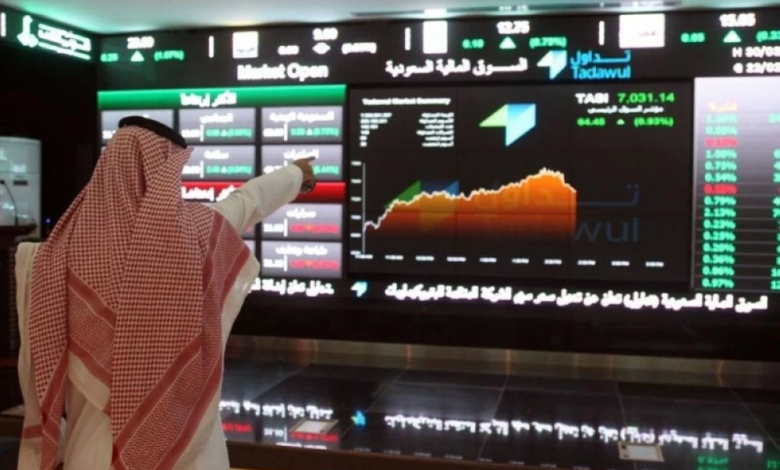
The Saudi Stock Exchange's main index (TASI) witnessed a notable decline at the close of trading today, impacting market performance. The index fell by 109.44 points , settling at 10,416.65 points . This decline was accompanied by cautious trading, with a total value of approximately 2.3 billion riyals , reflecting a state of anticipation among traders during the session.
According to the Saudi Press Agency's daily economic bulletin for the stock market, 136 million shares were traded. Market data revealed a clear divergence in the performance of listed companies, with only 30 companies' shares recording an increase in value, while the screens were predominantly red, reflecting a decline in the shares of 234 companies, indicating widespread selling pressure across most sectors.
Highest and lowest
In terms of company performance, shares of Flynas, AMAC, SADARAT, ROOM, and Saudi Cable topped the list of gainers. Conversely, shares of Integrated, Wafrah, CGS, Leejam Sports, and the Saudi Research and Media Group saw the largest declines. The percentage changes for these companies ranged between 5.08% and 8.35%, reflecting active price fluctuations in speculative and mid-cap stocks.
Market activity and leading companies
In terms of trading activity and liquidity, shares of Americana, Exports, Saudi Aramco, Saudi Chemical, and BATC accounted for the largest share of traded volume. However, in terms of monetary value, shares of Saudi Aramco, Al Rajhi Bank, stc, Elm, and Al Masar Al Shamel were the most actively traded, confirming the continued focus of institutional and individual liquidity on leading stocks with stable returns, despite the decline in the general index.
Parallel market (growth)
In a related development, the Saudi parallel market index (Nomu) was not immune to the declines, closing down 186.91 points at 23,244.02 points. Trading volume in the parallel market reached approximately SAR 17.2 million, with over 2.8 million shares traded, reflecting the more volatile nature of this market compared to the main market.
Market context and the importance of liquidity
This decline comes as investors closely monitor global and local economic developments, with oil prices and interest rates playing a pivotal role in guiding the direction of the Saudi stock market, the largest in the Middle East and North Africa region. The liquidity level recorded today (2.3 billion riyals) is relatively low compared to historical averages during periods of high demand, which analysts may interpret as a temporary lull or a wait for new catalysts to restore the market's usual activity.
The Saudi market's movements are of particular importance given its weight in global emerging market indices and its direct impact on investor sentiment in the region. Current support levels for the index are being closely watched as the market seeks to consolidate above the 10,400-point mark to establish a new base for recovery in the coming sessions.