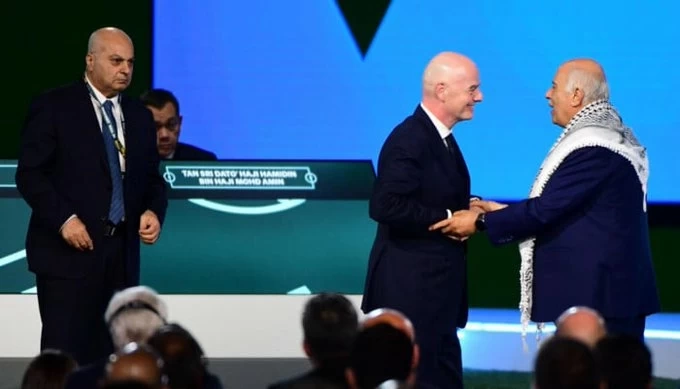
Rajoub refuses to shake hands with Israel's representative at the FIFA Congress

In a striking scene reflecting the deep political tensions in the world of sports, the head of the Palestinian Football Association, Jibril Rajoub, refused to shake hands with his Israeli counterpart, Bassem Sheikh Suleiman, during the 76th FIFA Congress. This firm stance came despite repeated attempts and intense urging from FIFA President Gianni Infantino, who sought to bring the two together in a symbolic gesture on the main stage before the delegations of the world's football federations.
The incident, which took place in Vancouver, Canada, began when Infantino invited both Rajoub and Suleiman to the podium after they had delivered their speeches, in an attempt to project an image of “unity and cooperation.” Infantino placed his hand on Rajoub’s arm and repeatedly urged him to approach and shake hands with the Israeli Football Association representative, but Rajoub categorically refused, visibly displeased, before leaving the podium in a tense moment that drew the attention of all those present and the international media.
Background of the Palestinian-Israeli sports conflict
This stance was not a spur-of-the-moment decision, but rather the culmination of years of deep-seated disputes and complaints lodged by the Palestinian Football Association with FIFA. The Palestinian side has consistently demanded sanctions against the Israeli Football Association for what it describes as "systematic violations" against Palestinian sports. These complaints center on several key points, most notably the participation of football clubs from Israeli settlements built on occupied West Bank land in Israeli leagues. The Palestinian Football Association considers this a direct violation of FIFA regulations, which prohibit a member association from organizing matches on the territory of another member association without its consent.
Furthermore, Palestinians complain of the severe restrictions imposed by Israeli authorities on the movement of Palestinian players, coaches, and referees between the Gaza Strip and the West Bank, as well as when traveling to participate in international tournaments, which significantly hinders the development of Palestinian football. The Palestinian Football Association has also documented cases of attacks on sports facilities and the arrest of players, issues that have been repeatedly raised with FIFA without any decisive action being taken.
The expected dimensions and effects of the situation
Rajoub's refusal to shake hands carries significant political and sporting implications. Locally and regionally, the stance is seen as a powerful message rejecting sports normalization with Israel while the occupation and its practices against the Palestinian people continue. This position was widely welcomed by Palestinian and Arab public opinion, which views sports as a platform for expressing national stances. In subsequent statements, Rajoub justified his position by saying he could not shake hands with someone representing a "fascist and racist government," emphasizing that "national dignity" takes precedence over any protocol and that sports should not be used as a tool to "whitewash" the policies of the occupation.
Internationally, this event puts FIFA and its president, Gianni Infantino, in a difficult position, highlighting the failure of the policy of “keeping politics out of sport” in dealing with complex issues such as the Israeli-Palestinian conflict. It also increases pressure on the international organization to take more seriously the Palestinian grievances that have been pending for years and to examine the Israeli Football Association’s compliance with FIFA regulations. This situation underscores that attempts to impose peace through symbolic gestures will not succeed unless the root causes of the problem—the political and legal issues on the ground—are addressed.