Crown Prince receives German Chancellor: Talks to strengthen strategic partnership

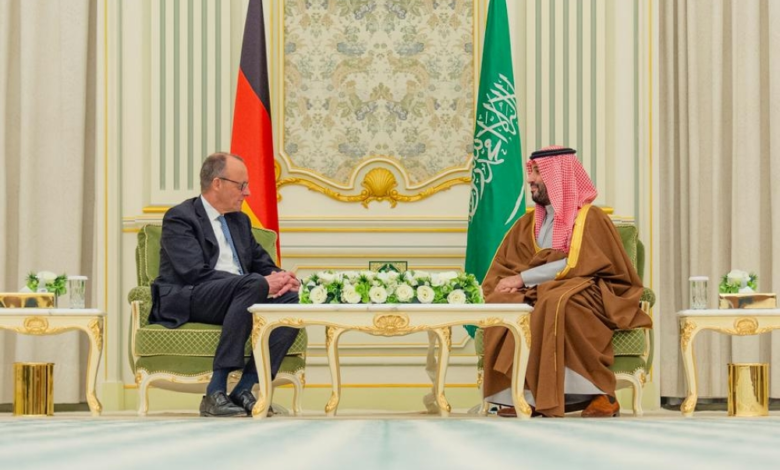
His Royal Highness Prince Mohammed bin Salman bin Abdulaziz Al Saud, Crown Prince and Prime Minister, received at the Royal Court in Al-Yamamah Palace in the capital Riyadh this evening, the Federal Chancellor of the Federal Republic of Germany, Friedrich Merz, where an official reception ceremony was held for him befitting the level of strong relations that bind the two friendly countries.
Official talks session to enhance cooperation
His Royal Highness the Crown Prince and the German Chancellor held an expanded official meeting, which His Royal Highness began by welcoming the Kingdom's guest and emphasizing the deep historical ties between the Kingdom of Saudi Arabia and the Federal Republic of Germany. For his part, the German Chancellor expressed his great pleasure at visiting the Kingdom and meeting His Royal Highness the Crown Prince, praising the pivotal role the Kingdom plays on both the regional and international stages.
During the meeting, the two sides conducted a comprehensive review of bilateral relations and ways to develop them across various vital sectors. These discussions come at a crucial time, as the world faces economic and political challenges that necessitate close coordination among influential nations. Germany is the largest economy in Europe, while the Kingdom of Saudi Arabia carries significant economic and political weight as a leader in the G20 and the architect of the ambitious Vision 2030.
Strategic partnership and future prospects
The meeting addressed promising opportunities for cooperation, particularly in the fields of renewable energy, green hydrogen, technology, and industry. The Kingdom, through its strategic vision, seeks to localize advanced German technologies, while Germany views the Kingdom as a reliable strategic partner in energy security and the stability of global markets. Discussions also covered the latest regional and international developments and efforts to achieve security and stability in the region, reflecting a shared vision on the necessity of joint action to defuse crises.
High-level attendance
The Saudi delegation attending the talks included His Royal Highness Prince Abdulaziz bin Salman bin Abdulaziz, Minister of Energy; His Royal Highness Prince Turki bin Mohammed bin Fahd bin Abdulaziz, Minister of State and Member of the Council of Ministers; His Royal Highness Prince Mohammed bin Abdulrahman bin Abdulaziz, Deputy Governor of Riyadh Region; His Royal Highness Prince Abdullah bin Bandar bin Abdulaziz, Minister of the National Guard; His Highness Prince Faisal bin Farhan bin Abdullah, Minister of Foreign Affairs; and His Highness Prince Badr bin Abdullah bin Farhan, Minister of Culture. Also present were Dr. Musaed bin Mohammed Al-Aiban, Minister of State and Member of the Council of Ministers and National Security Advisor; Dr. Majid bin Abdullah Al-Qasabi, Minister of Commerce; Mr. Mohammed bin Abdullah Al-Jadaan, Minister of Finance (the accompanying minister); Eng. Khalid bin Abdulaziz Al-Falih, Minister of Investment; and His Royal Highness Prince Abdullah bin Khalid bin Sultan, Ambassador of the Custodian of the Two Holy Mosques to Germany.
On the German side, those present included State Secretary and Federal Government Spokesperson Stephan Cornelius, German Ambassador to the Kingdom Michael Kindsgrab, Advisor to the Federal Chancellor on Foreign and Security Policy Günter Sautter, Advisor to the Federal Chancellor on Economic and Financial Policy Levin Höle, and a number of senior officials in the German government.