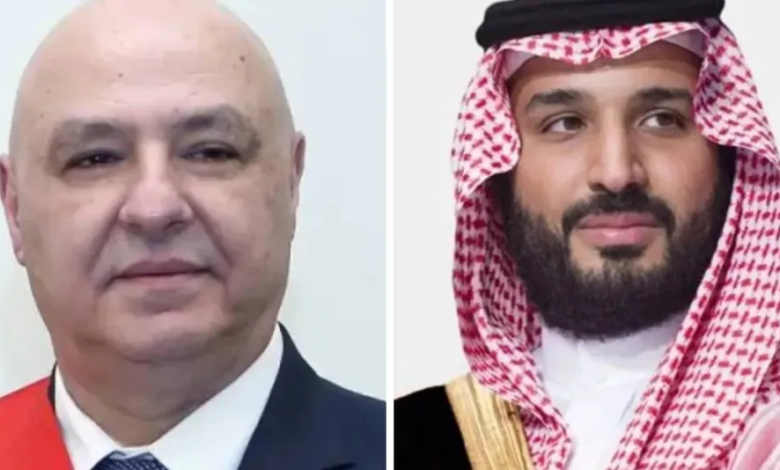

Saudi Crown Prince Mohammed bin Salman received Lebanese Army Commander General Joseph Aoun in Riyadh for a high-level meeting during which they discussed the latest developments in Lebanon. This meeting comes at a critical juncture for Lebanon, giving it exceptional importance both domestically and regionally, and reflects the Kingdom of Saudi Arabia's deep concern for Lebanon's stability and its support for its legitimate institutions.
This meeting comes against a complex backdrop for Lebanon, which is facing one of the worst economic and financial crises in modern history, ranked by the World Bank among the ten most severe global crises since the mid-19th century. This crisis has led to a near-total collapse of public services, an unprecedented devaluation of the national currency, and record-high poverty and unemployment rates. This economic collapse coincides with a continuing presidential vacuum and political paralysis that are hindering the implementation of the necessary reforms to save the country, pushing the Lebanese state and its institutions to the brink of complete collapse.
Amid this bleak landscape, the Lebanese Armed Forces, under the leadership of General Joseph Aoun, stand out as one of the last pillars of the state capable of maintaining a modicum of security and stability in the country. The Lebanese Army plays a pivotal role in preserving internal security, combating terrorism, and preventing a descent into total chaos. However, this vital institution has not been immune to the repercussions of the crisis, as the salaries of its soldiers and officers have been significantly eroded, threatening its ability to continue performing its duties effectively. The army has received sustained international and Arab support to prevent its collapse.
Historically, Saudi Arabia has played a pivotal role in supporting Lebanon politically and economically. However, relations have cooled in recent years due to the growing influence of Hezbollah, backed by Iran, and its dominance over political decision-making in Lebanon. This meeting reaffirms that the Kingdom continues to consider Lebanon's stability an integral part of regional security, and that it views the Lebanese army as a reliable partner and a unifying national institution that can be counted on to preserve Lebanon's sovereignty and unity, free from the control of militias and foreign agendas.
The significance of the meeting lies in the multiple messages it conveys. Domestically, it represents a major morale boost for the Lebanese army and its leadership, and may pave the way for direct Saudi and Gulf aid to bolster the military institution's resilience. Regionally, it sends a clear message that Riyadh will not relinquish its role in Lebanon and that it supports legitimate state institutions in confronting projects that threaten Lebanon's Arab identity and independence. Internationally, this move aligns with the efforts of countries like the United States and France to support the Lebanese army as the last bulwark against complete chaos.