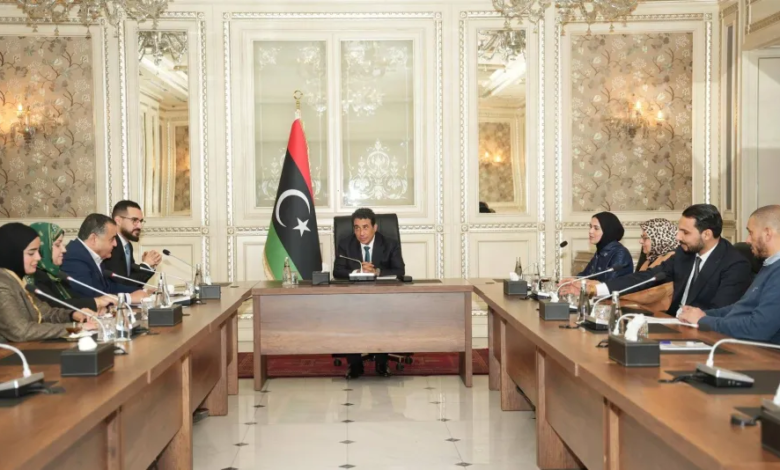

The exile calls for an end to the political stalemate in Libya
The head of Libya's Presidential Council, Mohammed al-Manfi, called on all political actors and stakeholders in Libya to prioritize the supreme national interest and work diligently towards consensus to hold the anticipated elections. This urgent appeal comes amidst the ongoing political stalemate in the country, as the Presidential Council strives to bridge the gaps between the various political factions to ensure a solid constitutional and legal foundation that paves the way for free, fair, and transparent presidential and parliamentary elections, fulfilling the Libyan people's aspirations for stability and the establishment of a state based on institutions.
Historical background of the Libyan electoral crisis
Historically, since the overthrow of the previous regime in 2011, Libya has been experiencing a complex and intertwined political and security crisis, punctuated by multiple transitional phases and sharp institutional divisions that have impacted the state's structure. The country was scheduled to hold crucial elections on December 24, 2021, but deep disagreements over electoral laws and candidacy requirements prevented their completion at the last minute. Since then, the United Nations, through its Support Mission in Libya (UNSMIL), has been making concerted and continuous efforts to bring together the House of Representatives and the High Council of State to agree on the outcomes of the "6+6" committee tasked with drafting electoral laws, with the aim of ending the transitional phases that have burdened both the state and its citizens.
Local impact: Towards institutional unification and reconciliation
Domestically, the agreement to hold elections represents a pivotal and historic step toward ending institutional division and unifying the executive branch and the military and security establishment under a single umbrella. The success of this democratic process will contribute directly and effectively to achieving comprehensive national reconciliation and improving the living and economic conditions of citizens who have suffered for years from the deterioration of basic services and the high cost of living. Furthermore, the existence of a single, democratically elected government will strengthen the principles of transparency and accountability in the management of national resources, particularly oil revenues, which are the lifeblood of the Libyan economy.
The regional and international importance of stability in Libya
Regionally and internationally, the Libyan situation is of great interest and close monitoring by the international community. Political and security stability in Libya necessarily means strengthening national security in North Africa and the Sahel-Saharan region, significantly curbing the activities of terrorist groups, organized crime gangs, and the arms trade. For Europe and the international community as a whole, ending the Libyan crisis plays a crucial and strategic role in controlling waves of illegal migration across the Mediterranean, as well as ensuring the stability of global energy supplies, given that Libya is one of the most prominent and important oil and gas producers in the Mediterranean basin.
Conclusion: Political will is the key to the solution
In conclusion, Mohamed Al-Manfi’s repeated call remains a crucial reminder that the fundamental solution to the Libyan crisis must be a purely “Libyan-Libyan” solution, free from negative foreign interference. This requires genuine political will and courage from all actors to make the necessary concessions, move beyond narrow factional interests, and take firm steps toward building the state of law and institutions that all Libyans aspire to and deserve after years of suffering.