The conjunction of the moon and Jupiter graces the skies of the Arab world today

Introduction to the upcoming astronomical event
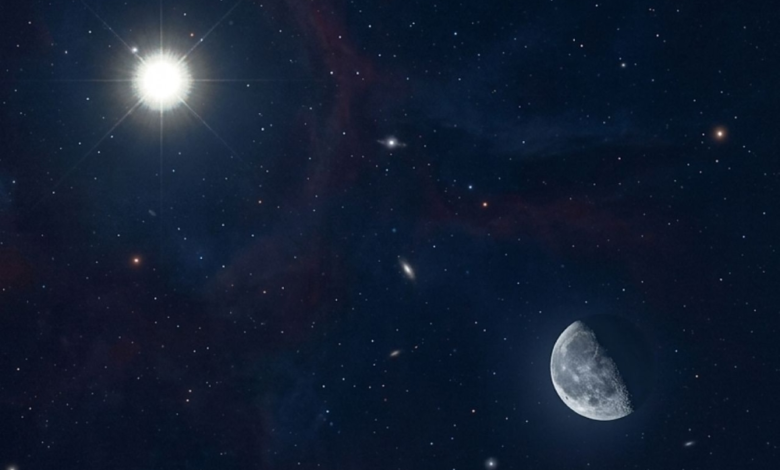
Astronomy enthusiasts and those interested in natural phenomena across the Arab world will be turning their attention to the skies this evening, Thursday, March 26, 2026, to witness one of the most beautiful astronomical events. The Jeddah Astronomical Society has announced a remarkable conjunction between the waxing gibbous moon and Jupiter, the giant planet of our solar system. This celestial spectacle presents an ideal opportunity for astronomical observation and photography.
The scientific and historical context of the phenomenon of conjugation
Historically, conjunctions have always been of interest to ancient civilizations, particularly the Arab and Islamic civilizations, which excelled in astronomy and used the positions of stars and planets to determine seasons and directions. Scientifically, a conjunction is defined as the appearance of two celestial bodies close to each other in the sky from our perspective on Earth, even though the actual distance between them in the vastness of space is estimated at millions of kilometers. Jupiter, the largest planet in the solar system, possesses immense gravity and a long history of discoveries that have transformed our understanding of the universe, most notably when Galileo Galilei pointed his telescope at it in the 17th century.
Visual scene details in the skies of the Arab world
In this context, Engineer Majed Abu Zahra, President of the Jeddah Astronomical Society, explained that this astronomical event will become clearly visible immediately after sunset and into the early evening hours. The Moon and Jupiter will appear close together at a considerable height in the sky, and will continue their conjunction for most of the night. Abu Zahra noted that Jupiter will appear to the naked eye as an exceptionally bright white point, outshining the vast majority of stars, alongside the waxing gibbous Moon in a breathtaking visual spectacle. The stars of the Gemini constellation will also be prominent in the same area, creating a complete and easily distinguishable astronomical display, even for those without specialized knowledge.
How to observe and the importance of using telescopes
One of the most remarkable aspects of this event is its ease of observation with the naked eye, requiring no complex equipment. However, the head of the Jeddah Astronomical Society added that using a small stargazer or a simple telescope will offer observers an exceptional experience, allowing them to see finer details. Among the most significant of these details is the appearance of Jupiter's four largest moons, historically known as the "Galilean moons" (Io, Europa, Ganymede, and Callisto). These moons will appear as tiny points of light precisely aligned around the giant planet, connecting modern observers to Galileo's historical observations.
The apparent and actual motion of celestial bodies
Regarding the dynamic movement of these celestial bodies, Engineer Abu Zahra explained that the Moon and Jupiter will appear to move towards the western horizon during the night. This is due to the apparent motion caused by the Earth's rotation on its axis from west to east. However, the Moon's actual movement in its orbit among the stars and along the ecliptic is eastward. This difference in motion leads to the observation that the Moon gradually moves away from Jupiter on subsequent nights when attempting to observe them simultaneously.
The importance of the event and its expected impact
At both the local and regional levels, such phenomena play a vital role in promoting scientific culture and spreading astronomical awareness among members of society, especially youth and students. They provide an open-air natural laboratory that stimulates scientific thinking and contemplation of the Creator's magnificence and the precision of the cosmic order. Abu Zahra concluded his statement with a general invitation to the public to turn their gaze to the sky tonight, to enjoy this dazzling cosmic display that reflects the vastness of the universe and reminds humanity of its place within this immense celestial system.