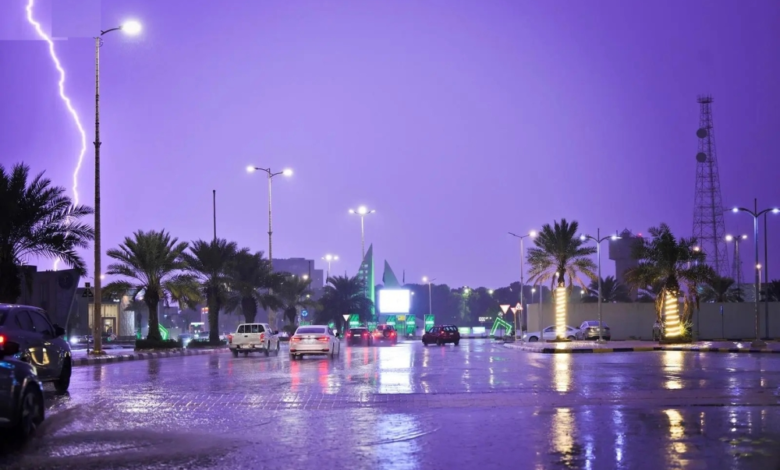
Weather forecast for Saudi Arabia: Thunderstorms and flash floods expected on Thursday

Weather forecast for Saudi Arabia on Thursday
The National Center for Meteorology in Saudi Arabia issued its daily weather forecast for Thursday, indicating a continued chance of moderate to heavy thunderstorms across large parts of the Kingdom. The center warned that these storms could lead to flash floods and will be accompanied by hail and strong winds that will stir up dust and reduce horizontal visibility.
The areas affected by the heavy rainfall include the Eastern Province, Riyadh, Qassim, Hail, the Northern Borders, Al-Jawf, Tabuk, and parts of the Madinah and Makkah regions. Light to moderate rain is expected in the Al-Baha, Asir, Jazan, and Najran regions. The center also anticipates the formation of fog during the night and early morning hours in parts of these areas, making it crucial to exercise caution while driving.
Climatic context: The “Sarayat” season in the Arabian Peninsula
This wave of weather fluctuations is part of the typical spring weather pattern in the Arabian Peninsula, a transitional period known locally as the "Sarayat" or "Marawih" season. This season is characterized by the region being affected by low-pressure systems originating from the Mediterranean and Red Seas, which converge with warm, humid air masses from the south. This convergence leads to a state of extreme atmospheric instability, resulting in the formation of massive cumulonimbus clouds that cause sudden and heavy rainfall over a short period, often accompanied by hail and strong downdrafts. While these weather phenomena are a major contributor to replenishing the Kingdom's groundwater resources, they also pose a significant risk if preparedness is lacking.
Expected impacts and the role of stakeholders
This weather system will have direct impacts on daily life and infrastructure. Locally, affected cities are expected to experience traffic congestion, with the potential for water accumulation on roads and in tunnels. In this context, the General Directorate of Civil Defense is issuing repeated warnings to citizens and residents to stay away from valleys and floodplains, avoid low-lying areas, and follow official alerts issued by the relevant authorities. These conditions will also affect the agricultural sector, as floods and hail can damage crops, while rainfall is generally a blessing for farmers and water reserves. Regionally, the effects of this weather system may extend to neighboring Gulf countries, necessitating regional coordination in weather monitoring and the issuance of warnings.
Sea conditions details
Red Sea
Surface winds are expected to be northwesterly to southwesterly at speeds of 15 to 34 km/h in the northern and southern parts, potentially reaching 50 km/h towards the Gulf of Aqaba. In the central part, winds will be northerly to northwesterly at speeds of 10-34 km/h. Wave heights will range from half a meter to one and a half meters, potentially reaching two and a half meters towards the Gulf of Aqaba. Sea conditions will be slight to moderate, becoming rough towards the Gulf of Aqaba.
Arabian Gulf
Surface winds will be northwesterly to northerly at 15-35 km/h, potentially exceeding 50 km/h with the development of thunderstorms and rain. Wave height will range between half a meter and one and a half meters, possibly exceeding two meters with the development of thunderstorms. Sea conditions will be slight to moderate, becoming rough with thunderstorms and rain.