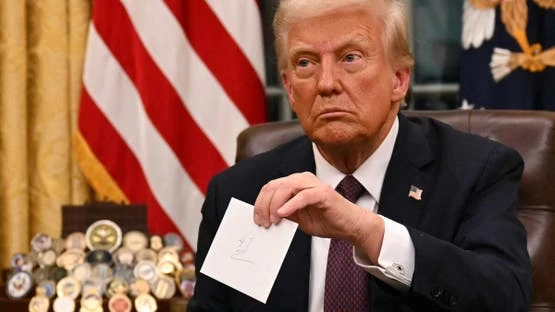

A historic precedent: Trump signs the US dollar bill
In an unprecedented move in the financial and political history of the United States, the U.S. Treasury Department announced that new banknotes will bear the signature of President Donald Trump. This extraordinary decision, made as part of the official celebrations marking 250 years of U.S. independence, represents the first time a sitting U.S. president has signed the federal currency.
This radical change includes another historic alteration, as the signature of the "United States Secretary of the Treasury" will be removed from banknotes for the first time in 165 years, ending a long-standing financial tradition that has lasted for more than a century and a half in printing American currency.
Details of the new release and its launch date
The Treasury Department explained in its official statement that the first banknotes to undergo this change will be the $100 bill. This bill will bear the signatures of President Donald Trump and Treasury Secretary Scott Bessent. Printing is scheduled to begin in June, with the printing of other denominations to follow gradually in subsequent months.
In this context, Treasury Secretary Scott Bisent stated that this move is a major national occasion to celebrate the founding of the United States. Bisent emphasized that this action reflects strong economic growth, financial stability, and the continued dominance of the U.S. dollar during Trump's second term. He added that there is no better way to celebrate the historic achievements of the country and President Trump than by issuing banknotes bearing his name, coinciding with the 250th anniversary of independence.
Historical background of US currency signatures
To understand the magnitude of this change, one must consider the historical context of the American currency. Since 1861, when the U.S. government began issuing federal paper money to finance the expenses of the Civil War, banknotes have traditionally carried two principal signatures: that of the Secretary of the Treasury and that of the Treasurer.
With this new decision, Lynne Malerba, Treasury Secretary in former President Joe Biden's administration (who also served under Treasury Secretary Janet Yellen), will be the latest in a long line of Treasury Secretaries whose signatures have appeared on the dollar bill. The Treasury Department's Bureau of Engraving and Printing is still producing banknotes bearing the Biden administration's signatures until the new decision takes effect.
The impact and importance of the decision, both locally and internationally
Domestically, changing the signature on the dollar is the latest effort by the Trump administration and its allies to immortalize the president's name on national landmarks and institutions. These efforts have included placing his name on government buildings, federal programs, warships, and coins. In this context, a federal technical committee—whose members were appointed by Trump himself—approved the design of a commemorative gold coin bearing his image.
At both the regional and international levels, any change to the US dollar attracts significant global attention. The dollar is not merely a local currency; it is the world's primary reserve currency and the driving force behind international trade and financial markets. While the change may be limited to form and signatures, it reinforces a political and economic message about the strength of the US economy, a message the current administration seeks to emphasize to the world. This reflects the intertwining of economics and politics in projecting American power on the international stage.