Saudi Arabia elected Vice-President of the International Telecommunication Union Council for 2026

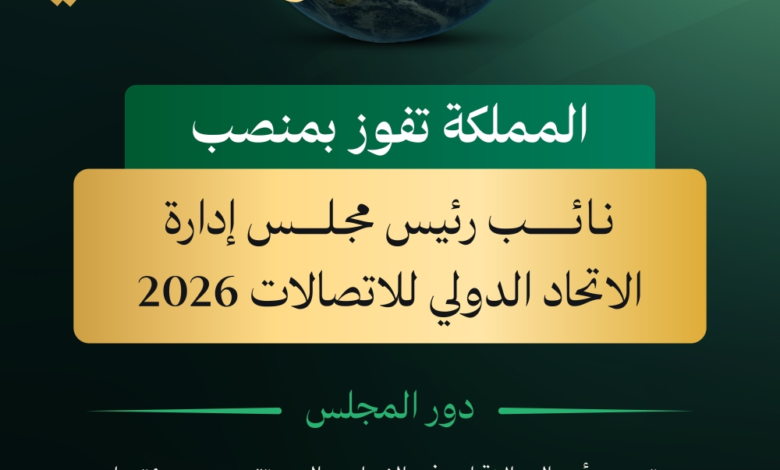
In a move reflecting growing international confidence in its pivotal role in the communications and information technology sector, the Kingdom of Saudi Arabia was unanimously elected to the position of Vice-President of the Council of the International Telecommunication Union (ITU) for 2026. This election took place during the Council session held in Geneva, Switzerland, where the Kingdom will be represented in this high position by the Undersecretary of the Ministry of Communications and Information Technology for International Cooperation and Partnerships, Professor Mansour bin Saleh Al-Qurashi.
This achievement is not just an honorary position, but a culmination of the Kingdom’s tireless efforts and active contributions in shaping global digital policies, and it confirms its position as a key player in achieving the Union’s goals of connecting the world and facilitating fair and sustainable access to digital technologies.
Historical background and the role of the International Telecommunication Union
Founded in 1865, the International Telecommunication Union (ITU) is the oldest international organization within the United Nations system and the specialized agency for information and communication technologies. Its primary mission is to coordinate the global shared use of the radio-frequency spectrum, promote international cooperation in the allocation of satellite orbits, improve telecommunications infrastructure in developing countries, and establish global standards that ensure the seamless interoperability of networks and technologies. The ITU Council, comprising 48 of the 190 member states, serves as the supreme governing body between Plenipotentiary Conferences and is responsible for the management of the Union's business and the implementation of its financial and operational policies and strategies.
The importance of the achievement and its expected impact
The Kingdom's election to this position carries significant strategic implications on various levels:
- Domestically, this victory aligns directly with the goals of Saudi Vision 2030, which places digital transformation and technological leadership at the heart of its objectives. This achievement reinforces the Kingdom's position as a regional hub for innovation and technology, and underscores the success of its substantial investments in digital infrastructure and the development of national talent.
- At the regional level: This position enhances the Kingdom’s leadership role in the Arab world, enabling it to better represent the region’s interests in international forums and contribute to addressing common challenges such as bridging the digital divide, promoting Arabic digital content, and developing regional cybersecurity policies.
- At the international level, this influential position will enable the Kingdom to contribute more effectively to shaping the future of global policies and standards related to emerging technologies such as artificial intelligence, the Internet of Things, and 6G networks. It will also strengthen its role in international initiatives aimed at achieving sustainable development through technology and ensuring the building of a secure and inclusive global digital space for all.
It is worth noting that the Kingdom of Saudi Arabia has been an active member of the Council of the International Telecommunication Union since 1965, where it has consistently participated positively in all of its activities, which has built up a great deal of international trust and respect, culminating today in this global consensus.