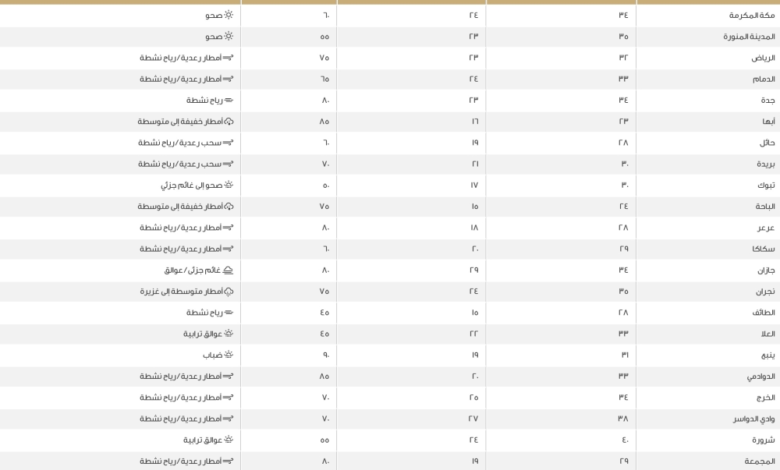

The National Center for Meteorology in Saudi Arabia issued its daily weather report, revealing a noticeable variation in minimum temperatures recorded across the Kingdom's cities and regions on Thursday night/Friday morning. The city of Dammam, located on the Arabian Gulf coast, recorded a minimum temperature of 24 degrees Celsius, reflecting the relatively mild weather the Eastern Province experiences during this time of year.
General context and climate diversity in the Kingdom
This temperature variation is a defining characteristic of Saudi Arabia's climate, stemming from its vast size and diverse geography. While coastal areas like Dammam, Jeddah, and Jazan enjoy warmer and more humid weather, the southwestern mountain ranges, such as Abha and Taif, experience cooler and more temperate conditions. In contrast, the interior and desert regions, like Riyadh and Qassim, are characterized by significant temperature differences between day and night. This diversity makes monitoring weather forecasts essential for the population and various sectors.
Temperature details in major cities
According to a statement from the National Center of Meteorology, the minimum temperatures in the main cities were as follows:
- Major cities: Mecca, Najran and Sharurah recorded 24 degrees Celsius, while Riyadh, Jeddah and Medina reached 23 degrees Celsius.
- Northern and Central Regions: Buraidah recorded 21 degrees, Sakaka and Dawadmi 20 degrees, Hail 19 degrees, Arar and Rafha 18 degrees, and Tabuk 17 degrees.
- Highlands and cold regions: The highlands were the coldest, with Taif, Al-Baha and Al-Qurayyat recording 15 degrees Celsius, and Tarif 14 degrees, while Al-Soudah was the coldest of all, recording only 10 degrees Celsius.
- Southern coastal areas: Jazan and Al-Ahsa recorded the highest minimum temperatures at 29 degrees Celsius, followed by Al-Qunfudhah and Wadi Al-Dawasir at 27 degrees.
The importance and impact of meteorological data
The reports of the National Center of Meteorology are of paramount importance at both the local and regional levels. Locally, citizens and residents rely on them to plan their daily activities, and they are vital to strategic sectors such as agriculture, which is directly affected by heat and frost, and the transport, air, and maritime sectors to ensure the safety of operations. Regionally, this accurate data contributes to understanding broader weather patterns in the Arabian Peninsula and helps in forecasting sandstorms or weather fluctuations that may affect neighboring countries, thus strengthening regional cooperation in meteorology and addressing shared climate challenges.