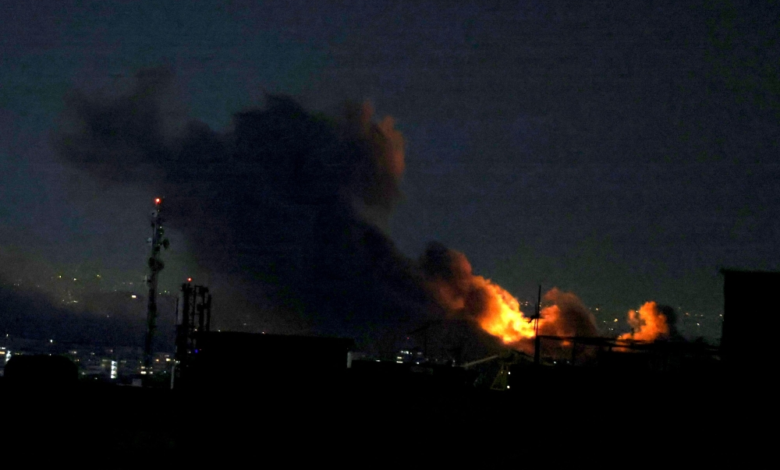

Israeli media reports indicate that the Israeli army has raised its alert level, noting significant military movements in the northern occupied Palestinian territories. These developments come as the Israeli leadership seriously considers various military scenarios in response to the recent Iranian attack, raising troubling questions about the potential for the region to descend into a full-blown war.
Background to the escalation: From Damascus to direct attack
This mobilization did not come out of nowhere; rather, it is part of a series of rapidly unfolding events that began with the targeting of the Iranian consulate in Damascus in early April, an attack attributed to Israel that resulted in the deaths of prominent leaders in the Iranian Revolutionary Guard. This attack marked a turning point, as Tehran vowed an inevitable and direct response, which it did.
In an unprecedented move, Iran launched a direct attack on Israel using hundreds of drones, ballistic missiles, and cruise missiles. Although Israel and its allies, primarily the United States and Britain, announced that they had intercepted the vast majority of the projectiles, the attack itself represented a strategic shift in the rules of engagement, moving the conflict from the shadows to direct confrontation.
Significance and potential impacts: Fears of a multi-front war
The danger of the current situation lies in the fact that any Israeli military response against Iran may not remain confined to the two countries. The military movements in northern Israel reflect a genuine concern about opening a front with Hezbollah in Lebanon, which is considered Iran's strongest proxy in the region and possesses a massive missile arsenal. A confrontation on the northern front, coinciding with a response against Iran, could lead to a devastating regional war, extending to Syria and potentially other parties, thus threatening the stability of the entire Middle East.
Internationally, calls for restraint are mounting. The United States is leading intensive diplomatic efforts to contain the situation, affirming its support for Israel's security while simultaneously urging it not to take any action that could escalate the conflict. World powers fear that a regional war would have catastrophic consequences for global energy security and the international economy, which is still reeling from a series of crises.
Ultimately, the region stands on the brink, awaiting the decision of Israel's war cabinet. This decision will not only determine the nature of the next phase of the confrontation with Iran, but could also shape the future of the Middle East for years to come.