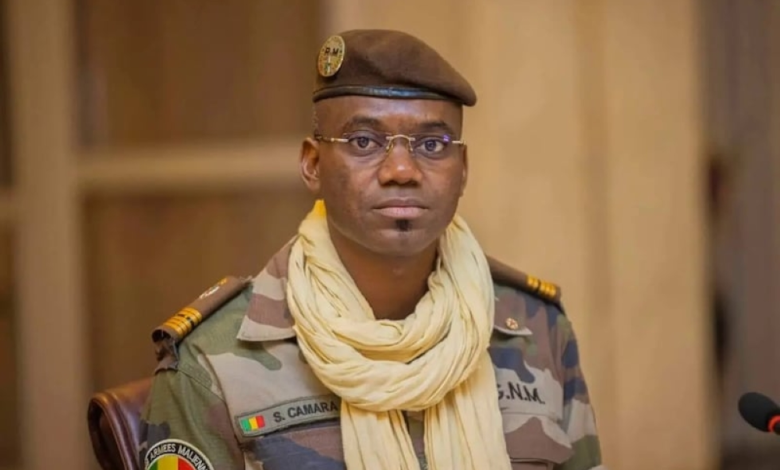

In a dangerous escalation of the security situation in Mali, the Malian government announced the assassination of Defense Minister Colonel Sadio Camara in a brazen terrorist attack targeting his residence in the military city of Kati. This attack represents a significant blow to the ruling military junta and raises serious questions about the state's ability to protect its top officials in the face of growing terrorist threats.
According to the official statement read by government spokesperson Issa Ousmane Coulibaly on national television, the attack was carried out by a suicide bomber driving a car packed with explosives. The bomber managed to reach the minister's residence and detonate the vehicle. The statement indicated that the car explosion was followed by a fierce gun battle between the minister's guards and the attackers, during which Colonel Camara was seriously wounded. He was taken to the hospital, where he later died.
The deteriorating security situation in the Sahel region
This assassination comes amid a deteriorating security situation in Mali and the Sahel region of Africa, which has persisted for over a decade. Since the outbreak of the insurgency in the north of the country in 2012, Mali has become a hotbed of activity for terrorist groups linked to al-Qaeda and the Islamic State, such as Jama'at Nusrat al-Islam wal-Muslimin (JNIM) and the Islamic State in the Greater Sahara (ISGS). Despite international military interventions, including the French Operation Barkhane and the recently concluded UN mission MINUSMA, these groups have continued to expand southward and into central Mali, carrying out complex attacks against both military and civilian targets.
The importance of the incident and its potential impact
The assassination of the defense minister, a key figure in the military junta that seized power in August 2020, represents a significant escalation in the terrorist groups' strategy. This attack not only demonstrates their ability to reach high-value targets in supposedly secure areas like Kati, home to the country's largest military base, but also aims to destabilize the transitional government and undermine the morale of the Malian army. Regionally, the incident sends a worrying message to neighboring countries facing similar security challenges and may prompt a reassessment of counterterrorism strategies in the Sahel. Local and international observers are now awaiting the Malian authorities' response and whether this incident will lead to an intensification of military operations against armed groups in the country.