KAUST Mathematics Competition concludes with the honoring of 241 gifted students

An exceptional conclusion to the KAUST Mathematics Competition
In a scientific achievement reflecting the ongoing development of the Saudi education sector, King Abdullah University of Science and Technology (KAUST) concluded the final round of the KAUST Mathematics Competition (KMC). This prestigious academic event was organized by the KAUST Academy, in strategic collaboration with the National Network for STEM Talents, and in active partnership with the Ministry of Education. The competition witnessed widespread participation, with over 7,640 students representing 13 educational districts and 59 different nationalities from across the Kingdom taking part.
Historical context and trend towards STEM fields
This national initiative comes at a time when the Kingdom of Saudi Arabia is undergoing a radical transformation towards building a knowledge-based economy. Since its founding, KAUST has been committed to leading scientific research and developing talent. The KAUST Mathematics Competition aligns with the Kingdom's long-standing efforts to promote STEM fields, aiming to discover and nurture mathematical talent among students at an early stage of their education, thus paving the way for a generation capable of innovation and solving complex problems.
Details of the final round and honoring the winners
The final round was held at the university's main campus from April 3rd to 5th, with 241 male and female students from grades 8 through 11 competing. These students qualified after passing through multiple rigorous elimination rounds in various cities across the Kingdom. The participants underwent advanced scientific tests covering algebra, geometry, combinatorics, and number theory, demonstrating a high level of analytical thinking and mathematical abilities.
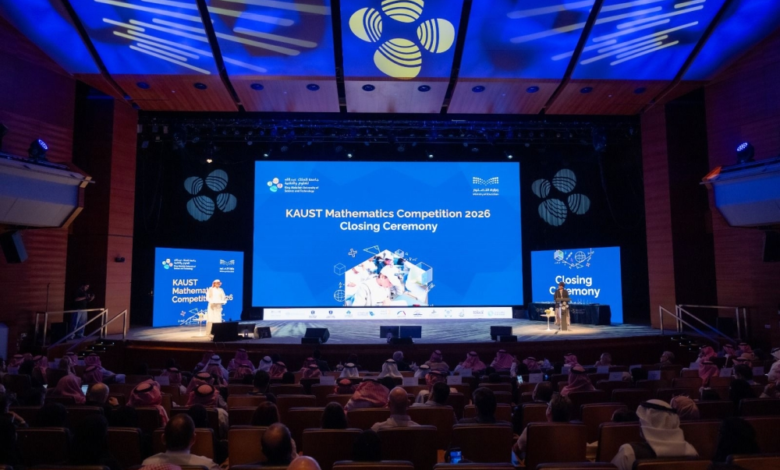
During the closing ceremony, outstanding students were awarded gold, silver and bronze medals in the junior and youth categories, in recognition of their exceptional performance that reflects the quality of national educational outcomes.
Top achievers
In the junior category, the gold medalists were:
- Faisal Mohammed Al-Bariqi
- Hassan Jihad Al-Rijal
- Jawad Ahmed Al-Nasser
- Mohammed Salem Al-Salmi
- Ahmed Raed Al-Thubaiti
- On Muhammad Sajjad
- Habib Luqman Hakim
- Fares Mohammed Al-Kanhal
- Hussein Abdullah Al Omran
- Mu'ammal Siraj Al-Sihaiti
- Emad Mohammed Al-Maliki
- Abdulrahman Ahmed Noursaid
In the youth category, he won gold medals:
- Ryan Abdulkarim Karim
- Ali Hassan Al-Hussein
- Tala Faisal Talaba
- Mohammed Nasser Al-Ali
- Abdul Rahman Shawqi Mansour
- Yasser Mohammed Habibullah
- Mohammed Ali Shaiban
- Abdullah Tariq Al-Amer
- Abdul-Ilah Muhammad Al-Saqqaf
- Bilal Nafeh Al-Hujaili
Awards for excellence were also presented to the top students in each grade: Mohammed Salem Ba’atiyah (first in the eighth grade), Emad Mohammed Al-Maliki (first in the ninth grade), Abdul-Ilah Mohammed Al-Saqqaf (first in the tenth grade), and Mohammed Ali Shaiban (first in the eleventh grade).
Importance and expected impact: locally and internationally
Dr. Sultan Al-Barakati, Associate Vice President for Saudi Talent Development at KAUST, explained that the competition is a unique initiative to discover promising scientific talent. Locally, the competition contributes to achieving the objectives of the Human Capital Development Program, one of the programs under Saudi Vision 2030. Internationally, it enhances the Kingdom's global competitiveness by preparing students for international forums.
The competition provided quality international educational opportunities, most notably qualifying to participate in the International Mathematical Olympiad preparation programs for 2028, and completing specialized training programs that include participation in the prestigious Cambridge University Summer Math Camp.
The role of faculty and the research environment
To ensure the highest quality standards, a select group of KAUST faculty and researchers participated in developing the competition questions. In addition, enrichment programs were implemented, including workshops and applied scientific sessions, allowing students to become familiar with the university's modern research environments. This fosters their early engagement with specialized scientific fields and opens up promising future prospects for them.