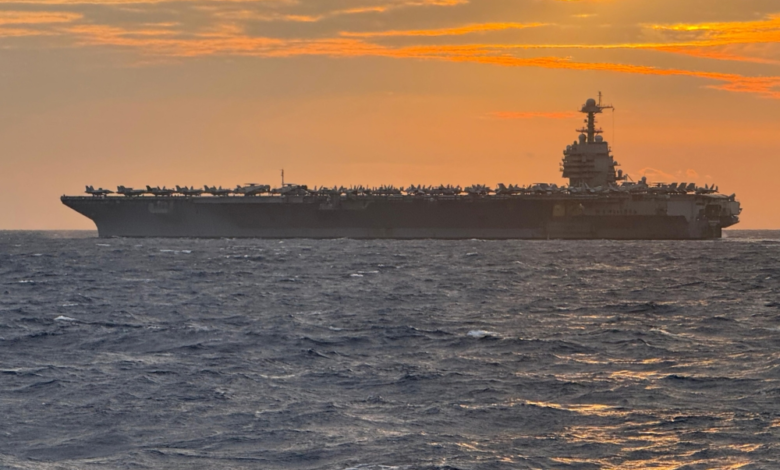

In a move with multiple strategic implications, the USS Gerald R. Ford (CVN-78), the newest and largest aircraft carrier in the world, departed the eastern Mediterranean and returned to its home port of Norfolk, Virginia. This deployment, following a lengthy and intensive period of deployment, is seen as a sign of the United States reassessing the level of threats in the region and seeking to balance its military presence globally.
Context of dissemination and its objectives
The aircraft carrier USS Gerald R. Ford and its strike group were deployed to the region following the October 7 attacks as part of a US deterrence strategy. Their primary objective was to send a clear message to Iran and its proxies in the region, most notably Hezbollah in Lebanon, to prevent them from exploiting the conflict in Gaza and escalating the war regionally. The presence of this formidable naval force, including cruisers and destroyers capable of launching guided missiles, formed a cornerstone of the US show of force aimed at ensuring regional stability and protecting its allies, particularly Israel.
The importance of the decision and its expected effects
The departure of the USS Gerald R. Ford comes at a sensitive time and can be interpreted in several ways. First, the Biden administration may see the risk of a wider regional war as having diminished and the deterrent message as having been delivered, thus allowing this strategic vessel to return home after completing its mission of more than eight months. Second, the decision reflects logistical and operational pressures on the U.S. Navy, as extended deployments take a toll on crews and equipment and require periods of maintenance and overhaul.
Regionally, this withdrawal could be interpreted as a de-escalation gesture, particularly given the ongoing tensions in the Red Sea with the Houthi attacks. However, Washington emphasizes that this does not signify an abandonment of its security commitments in the Middle East. The United States maintains a significant military presence in the region, including thousands of troops at land bases in several countries, as well as naval assets such as the USS Dwight D. Eisenhower carrier strike group, which has been deployed to the Arabian Gulf and the Red Sea to counter maritime threats.
Broader strategic repositioning
This move also falls within the broader context of the U.S. National Defense Strategy, which increasingly focuses on “great power competition,” specifically with China and Russia. This strategy requires a high degree of flexibility in the deployment of high-value military assets, such as aircraft carriers, to be able to respond to threats in different parts of the world, rather than keeping them concentrated in one region for extended periods. Therefore, the return of the USS Gerald R. Ford provides the Pentagon with broader strategic options and supports long-term force readiness.